Stop overpaying for your TMS: Why translation management doesn't have to cost a fortune

There's a common pattern in the translation management world.
A TMS shows €5/month on the pricing page.
It looks simple. Affordable. Safe.
Then the invoice arrives: €800+.
Recently, one SaaS team shared their real invoice and project export:
- 3,200 translation keys
- 33 languages
- ~107,000 translations
- ~1,250,200 words
They were charged:
- Subscription: €5
- Word volume: €800
- Minor modifications
- Downloads
The subscription wasn't the problem.
The structure was.
Why invoices grow faster than products
At first glance, 3,200 keys doesn't sound large.
But when pricing is based on word count, everything multiplies:
3,200 keys x 33 languages
Weekly UI updates
Marketing tweaks
Feature rollouts
A/B tests
Every change generates more words.
When you pay per word, growth directly increases your costs.
That's manageable for static websites.
It becomes unpredictable for SaaS products that ship continuously.
Many pricing models also meter:
- Word volume
- Language count
- API calls
- Downloads
- Edits or modifications
If you follow a modern setup like we describe in our Step-by-step localization workflow for developers, you're likely syncing and deploying often.
On some platforms, automation increases your bill.
That creates a strange incentive:
The more efficient your workflow, the more you pay.
How TMS pricing affects localization strategy
Tool pricing isn't just an operational detail. It influences strategy.
It affects:
- Which languages you can afford to launch
- Whether automation is financially safe
- Forecasting accuracy for finance teams
- How confidently you can scale
If adding 10 new languages forces a plan upgrade, expansion becomes a budgeting negotiation instead of a product decision.
We discuss language prioritization in our guide on planning your first five localization languages and explore international growth planning in more depth in our guide on localization strategy for global SaaS growth. The goal is to scale step-by-step, without introducing financial risk at every stage.
Localization strategy requires predictable tooling.
Example: The expansion trap
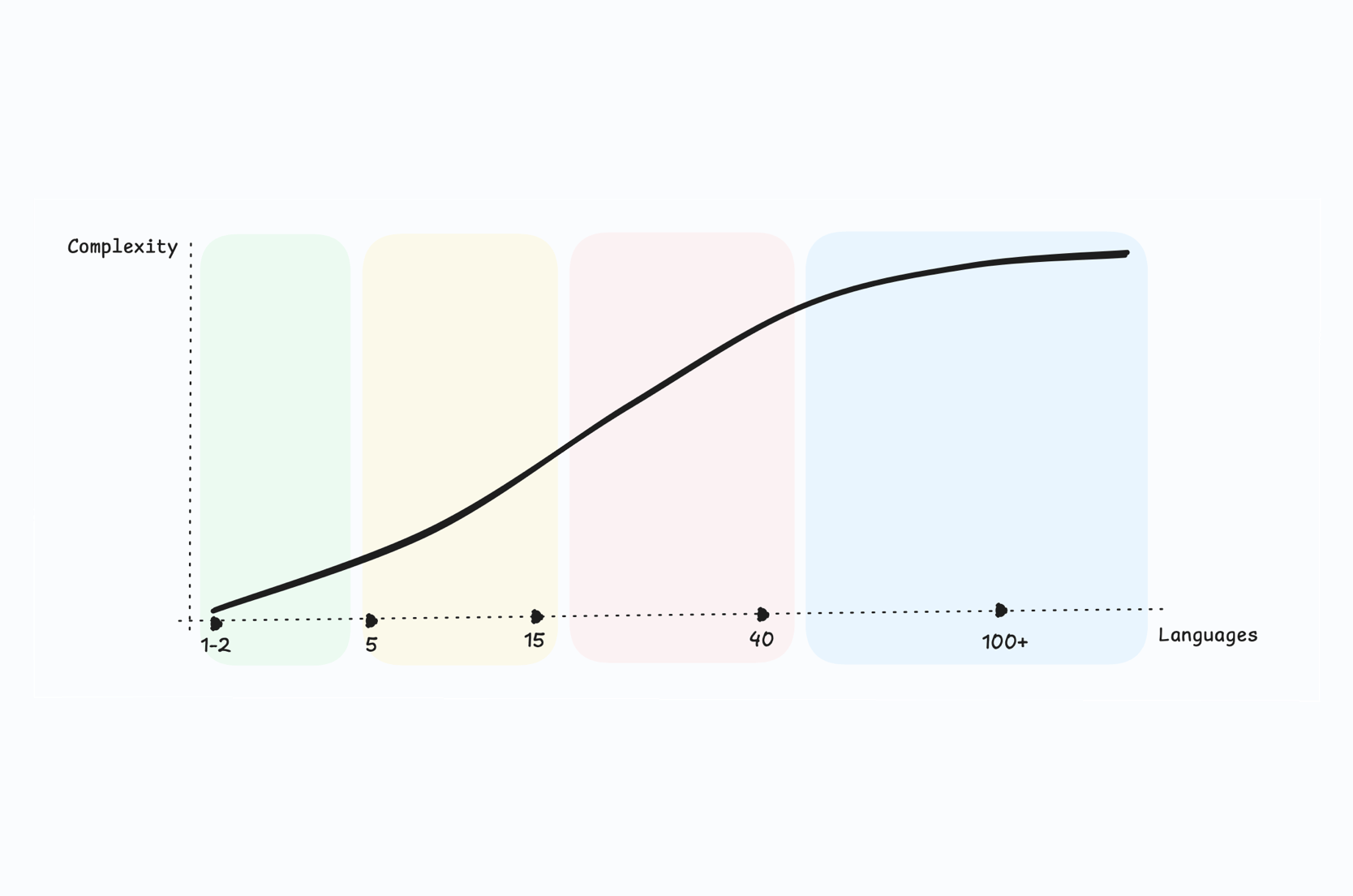
You start with five languages.
Traction improves.
You decide to expand to 20.
On many platforms, that means:
- Higher subscription tier
- Language limits removed only on enterprise plans
- Usage-based multipliers kick in
Your product hasn't fundamentally changed.
But your monthly cost has.
When pricing scales with activity rather than product size, international growth becomes financially volatile. You can't predict your costs as you expand.
The CI/CD multiplier
Modern SaaS teams automate localization:
- Sync keys on every merge
- Pull translations during build
- Deploy multiple times per day
This is standard in continuous localization.
But if API usage or downloads are metered, automation increases cost.
That discourages best practices.
A pricing model should support operational efficiency — not penalize it.
A more predictable model
One alternative is pricing based on product size: typically the number of translation keys.
In that structure:
- Add more languages → cost doesn't change
- Automate sync → cost doesn't change
- Download translations daily → cost doesn't change
- Edit content → cost doesn't change
You pay for the scope of your product, not for how actively you improve it.
That makes forecasting easier.
Finance teams know what to expect.
Founders can model expansion.
Product teams can automate without fear.
Not all word-based pricing is bad
For small, static websites or one-time translation projects, word-based pricing can make sense.
The issue appears when:
- You support many languages
- Your product changes weekly
- You automate localization
- You plan long-term global expansion
In those cases, pricing structure matters more than entry cost.
How to evaluate TMS pricing before committing
Before choosing a platform, ask:
- What happens if we double our languages?
- What happens if we update UI copy every week?
- Are API calls or downloads metered?
- Can we forecast costs at 50 languages?
- Is automation financially safe?
If the answers are unclear, your future invoices might be unclear too.
If you're building your long-term international roadmap, start with a clear foundation. Our complete localization strategy guide walks through market selection, prioritization, and scalable execution.
Localization tools should support growth
Localization is meant to help you:
- Enter new markets
- Improve conversion
- Ship faster
Your tooling should make that easier, not introduce financial anxiety.
Modern storage is inexpensive. APIs are standard. Automation is expected. High cost often comes from pricing architecture, not infrastructure limitations.
The best TMS is not the cheapest entry plan.
It's the one that scales predictably with your product.
If you're comparing platforms
If you re currently evaluating solutions, you may also want to review our comparison of the best translation management tools for SaaS.
For practical advice on choosing the right workflow at your team's stage, see how to pick a translation workflow for small teams.
And if you're planning international expansion, start with your market priorities first, then choose tooling that supports that strategy.
Localization should feel like a growth engine.
Not a billing surprise.