React Localization
made simple
Manage translations for React, Next.js, and React Native apps. From upload to AI-assisted translation and CDN delivery, everything runs in one unified workflow.
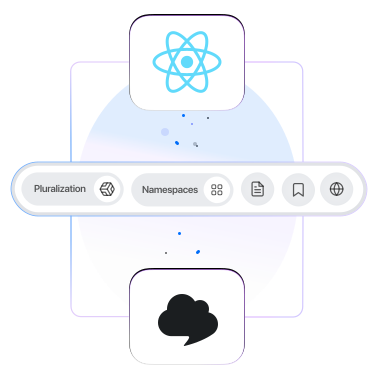
We power your product localization
From first commit to global launch














React i18n workflow
From strings to
global users
Upload your JSON translation files, translate with AI or your team, then deliver via CDN or download updated files for your next build.
All developer featuresUpload translations
Get your JSON file with translation keys or translations and upload it using the CLI or REST API.
- SimpleLocalize CLI is open-source and safe to use in your infrastructure
- Vendor-agnostic solution: all data can be exported any time in multiple formats
- Use REST API or web client to upload or download your data
simplelocalize upload \
        --apiKey YOU_API_KEY \
        --uploadPath ./source_messages.json \
        --uploadFormat single-language-json
Translate texts
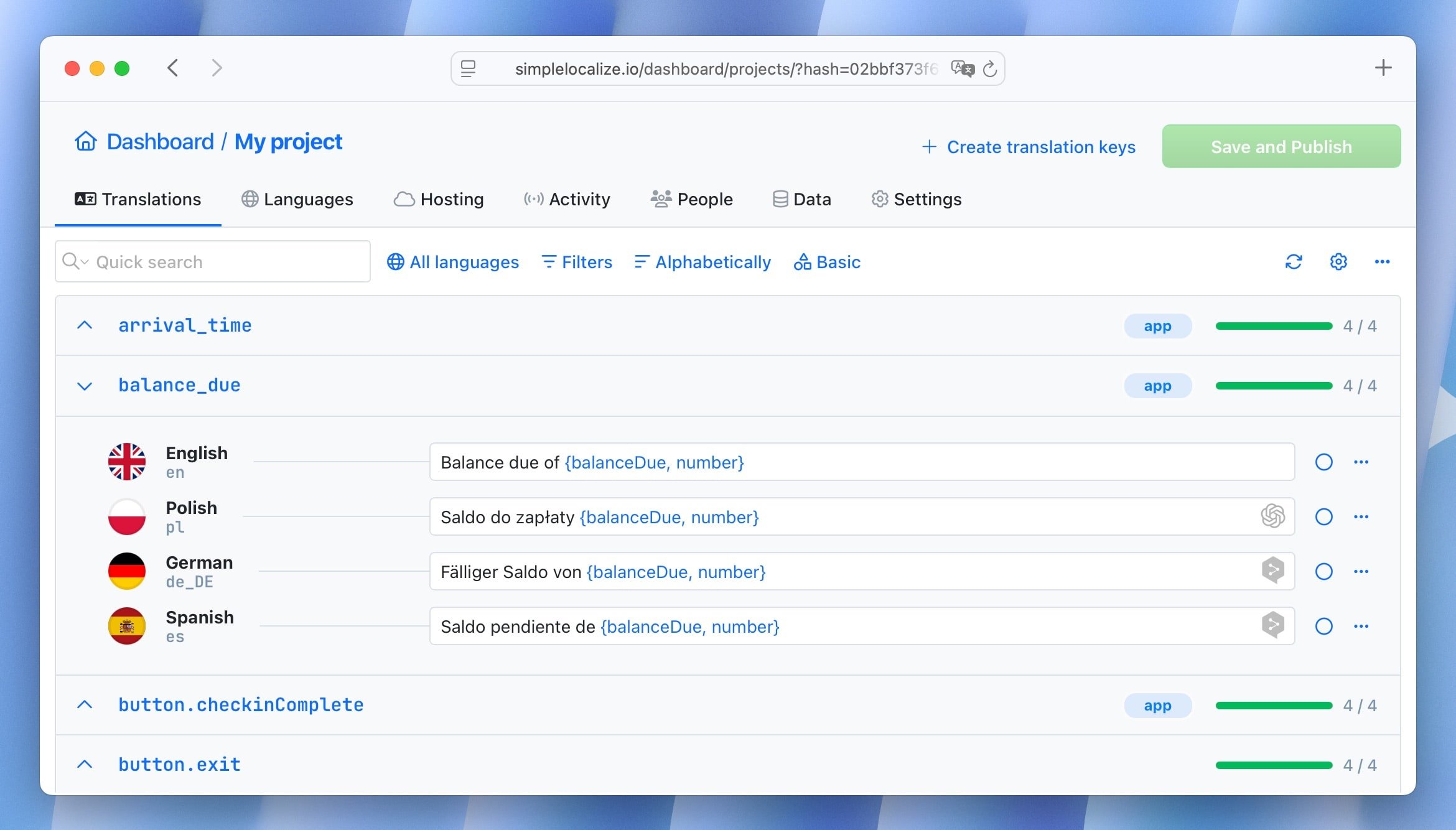
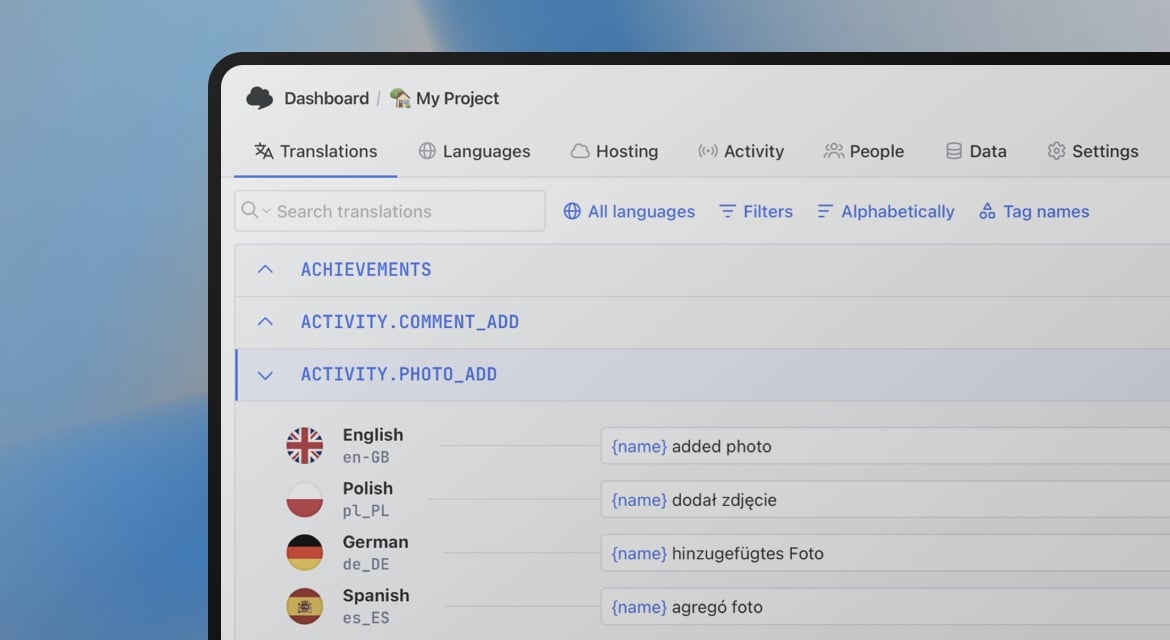
Your data will show up in a translation editor which can be handed over to translators or other team members.
- Translate with Google Translate, DeepL, OpenAI or custom AI models in seconds!
- Invite team members to the project
- Activity log shows what was happening with your translations
- Use quick rollback to revert translations to the previous version
Load translations
Fetch translations directly from the CDN or download them using our command-line application.
- CDN ensures fast access to translation data anywhere in the world in the most commonly used JSON format
- Translate once and re-use translations in other applications by changing the download format
- Fetching translations directly from CDN in your app allows you to change messages in real-time
{
  "en": {
    "CREATE_ACCOUNT": "Create account",
    "SIGN_IN": "Sign in",
    "WELCOME_TO_THE_JUNGLE" : "Welcome to the jungle"
  },
  "es": {
    "CREATE_ACCOUNT": "Crear cuenta",
    "SIGN_IN": "Iniciar",
    "WELCOME_TO_THE_JUNGLE": "Bienvenido a la jungla"
  }
}
Start localizing your React app today
Create a free project and upload your first translation file in minutes.
Start for freeWorks with every React i18n library
SimpleLocalize supports all major React internationalization libraries out of the box. Upload your files, manage keys in the editor, and download in whatever format your library expects.
Built for developer workflows
SimpleLocalize integrates into every part of your React development lifecycle, from local development to production CI/CD pipelines. See the full picture on the developer features page.
Translation delivery
Fix a typo
without a redeploy
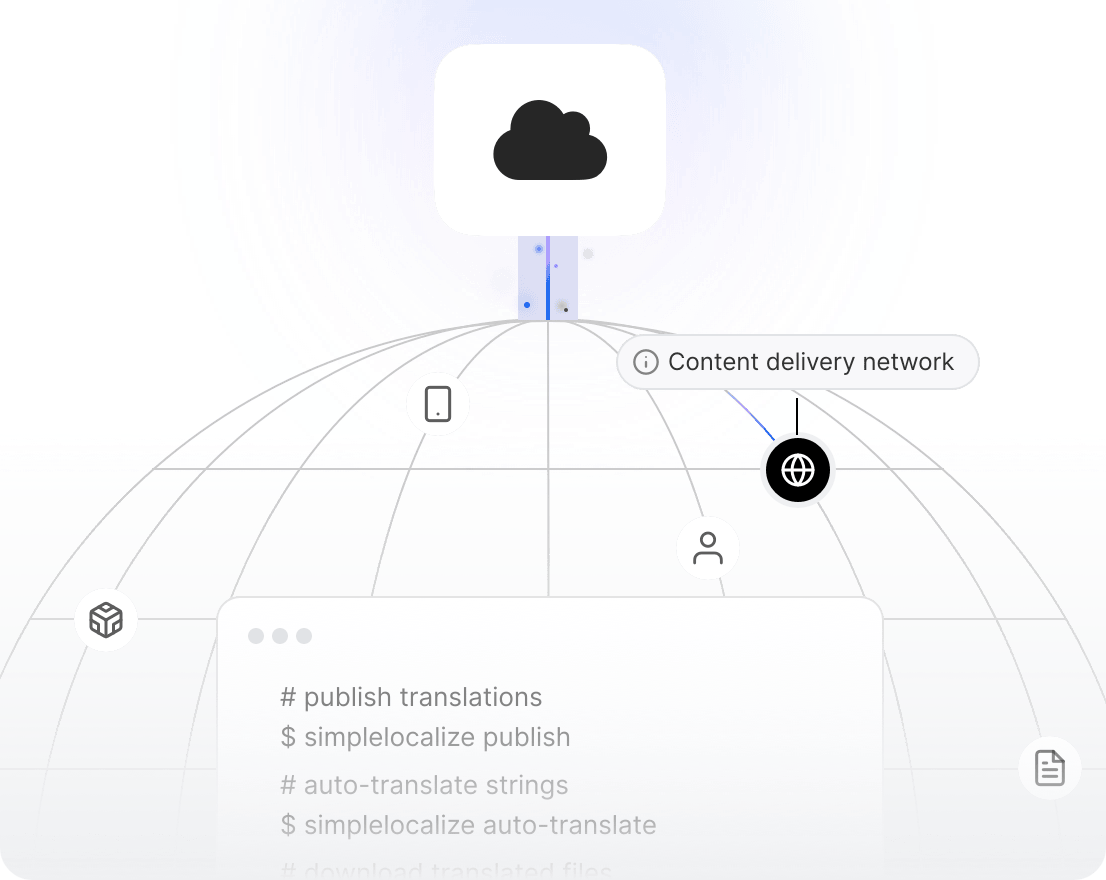
SimpleLocalize's Translation Hosting CDN lets React apps fetch the latest strings at runtime. Correct a key in the editor and it's live within seconds, no rebuild or deployment required.
Edge-cached JSON delivery
Translation files are served from our global CDN with low latency. Works with react-i18next, FormatJS, next-translate, and any JSON-based library.
Real-time updates
Apps using CDN fetch get the latest translations immediately after you publish. No code changes or deploys needed.
Environment support
Use separate latest and production environments to stage translations before pushing to your live React app.
Developer tools
Works with your favourite tools and plays nice with your current i18n stack.
Browse integrations



































Developer workflow
React i18n from
zero to shipped
Follow this workflow to internationalize your React app and start serving translated content to users worldwide.
Internationalize your React app
Install react-i18next, FormatJS, or next-translate. Wrap your app with the i18n provider and replace hardcoded strings with translation keys.
Upload strings to SimpleLocalize
Push your JSON translation files via CLI, GitHub Actions, or the web dashboard. SimpleLocalize detects your format and organizes keys automatically.
Translate with AI or your team
Auto-translate with DeepL, Google Translate, or OpenAI. Invite translators to review and approve in the online editor.
Deliver via CDN or file export
Publish translations to the CDN for instant updates, or download updated JSON files and bundle them with your next release.
For a step-by-step walkthrough, see the getting started guide.
Start localizing your React app today
- Works with react-i18next, FormatJS & next-translate
- AI-powered translations built in
- Translation hosting CDN for instant updates
- CLI, REST API & GitHub Actions integration
- Transparent, flat pricing
"The product
and support
are fantastic."
"The support is
blazing fast,
thank you Jakub!"
"Interface that
makes any dev
feel at home!"
"Excellent app,
saves my time
and money"
Related articles
Read more about React localization on our blog
next-intl guide for Next.js: Practical i18n architecture with SimpleLocalize
A practical next-intl guide for Next.js App Router: routing, request config, static rendering, type-safe messages, and a production workflow with SimpleLocalize.
react-i18next vs next-intl: Which should you use for React localization?
react-i18next and next-intl are the two most common choices for React localization. Here's a concrete breakdown of how they differ, when each fits, and how both integrate with SimpleLocalize.
How to localize a React app using i18next (Next.js App Router guide)
Learn how to localize a Next.js App Router project using i18next and react-i18next. Covers server and client components, middleware-based locale detection, hreflang SEO, and translation management with SimpleLocalize.
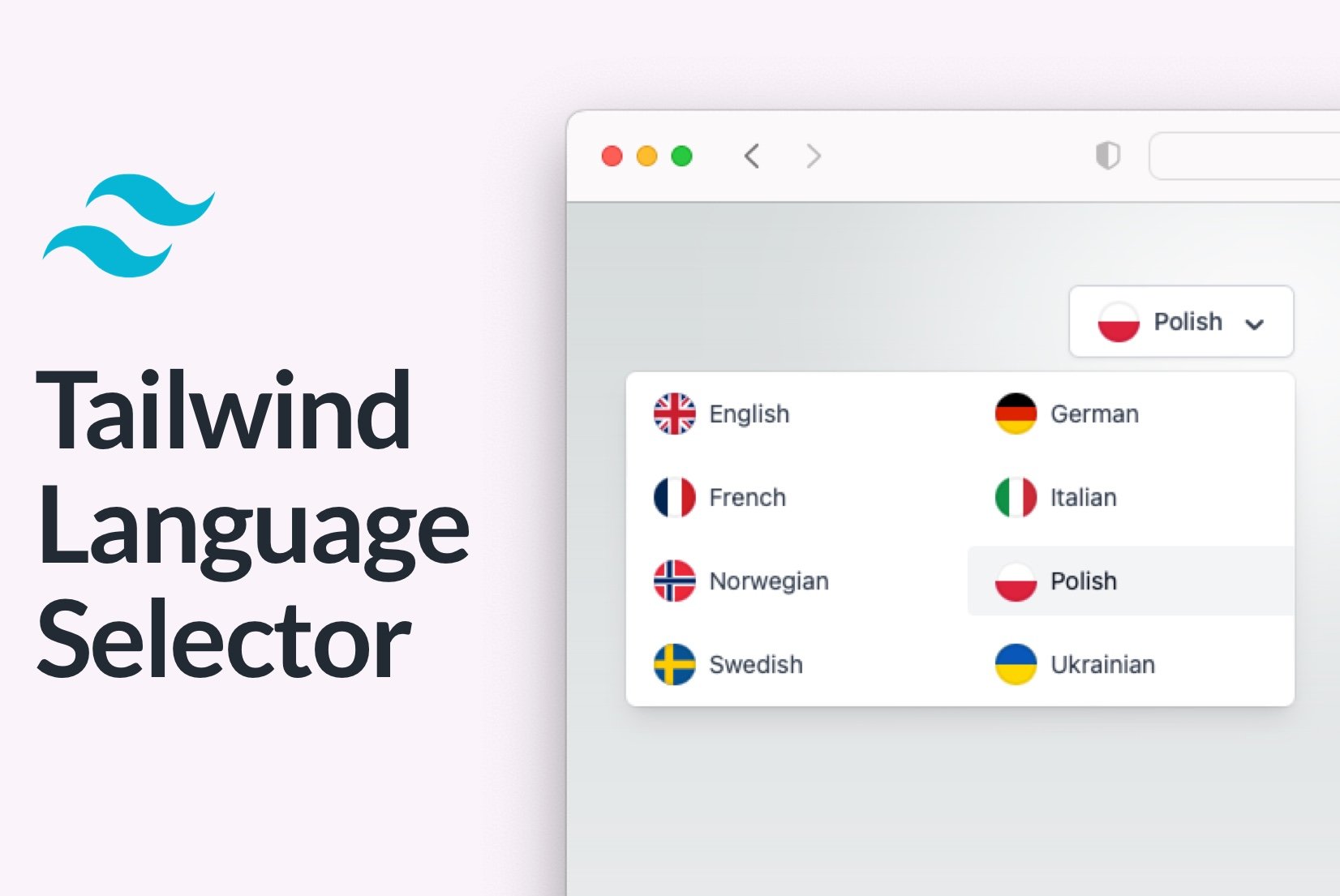
How to create a language selector with Tailwind CSS
Learn how to create a language selector for your website easily using Tailwind CSS. Follow our step-by-step guide for seamless localization.
How to translate a Next.js app with next-i18next
Step-by-step guide to localizing Next.js apps. Pages Router with next-i18next, App Router with i18next and react-i18next, pluralization, language selector, and SimpleLocalize integration.
How to localize a Next.js app with next-translate
A practical guide to localizing Next.js apps with next-translate. Covers Pages Router, App Router, TypeScript, middleware, SSR vs SSG, SimpleLocalize integration, and hreflang setup.
Frequently asked questions
What is React localization?
React localization (often called React i18n) is the process of adapting a React application for users in different languages and regions. It involves externalizing all user-facing strings into translation files, choosing an i18n library like react-i18next or FormatJS, and loading the correct translations based on the user's locale.
What i18n libraries does SimpleLocalize support for React?
SimpleLocalize supports all major React i18n libraries including react-i18next, i18next, FormatJS (react-intl), next-translate, typesafe-i18n, and any library that reads JSON files. Translation files can be uploaded, managed, and downloaded in the exact format each library expects.
How do I integrate SimpleLocalize with react-i18next?
Install the SimpleLocalize CLI, configure it to point at your locale JSON files, then run simplelocalize upload to push strings. After translating in the editor, run simplelocalize download to pull the updated files back. For CI/CD, use the GitHub Actions integration or GitHub App to automate both steps on every push.
Can I use SimpleLocalize with Next.js App Router?
Yes. SimpleLocalize works with any Next.js i18n setup, Pages Router or App Router. Upload your locale JSON files via CLI or API, manage them in the editor, and download them for bundling. For dynamic updates without rebuilds, use Translation Hosting to serve files from the CDN directly.
What is the difference between translation hosting CDN and file export?
File export downloads translation files to bundle with your app at build time, the standard approach for most deployments. Translation Hosting CDN serves the latest translations from our global edge network at runtime, allowing you to update copy without a redeploy. Both approaches work with react-i18next, FormatJS, and other JSON-based libraries.
Does SimpleLocalize support React Native?
Yes. React Native projects using react-i18next or similar JSON-based libraries work exactly the same way as React web projects. Upload your locale files, translate them, and download updated files. The Translation Hosting CDN also works for React Native apps that load translations at runtime.
How do I auto-translate React app strings?
Upload your source language JSON file to SimpleLocalize, then use the Auto-translate feature to fill target language strings using DeepL, Google Translate, OpenAI, or custom AI models. You can configure automations to auto-translate newly added keys on every upload, keeping translations in sync with your development workflow.