
Smartcat Alternative
for Developers
Smartcat is built for project managers and language service providers who need a marketplace of freelance translators and complex human workflows. SimpleLocalize is built for developers and product teams who want to manage translations like code with a CLI, CI/CD pipelines, and predictable pricing. If Smartcat feels like overkill for syncing your JSON files, you're not alone.
Same problem,
opposite ends of the spectrum
Both platforms help you translate software. The difference is who they were designed for and how they expect you to work.
SimpleLocalize
- Primary user: Developers & product teams
- Core workflow: CI/CD, CLI, API, code repositories
- Pricing: Flat tiers from $15/mo, no surprises
- Focus: Speed, automation, and simplicity
- Philosophy: Translations belong in the deployment pipeline

Smartcat
- Primary user: Project managers & LSPs
- Core workflow: Marketplace, human translators, AI agents
- Pricing: Enterprise-heavy, starting ~$1,200/year
- Focus: Scaling human workflows + AI agents
- Philosophy: Translations are a managed service
Both tools get the job done. The question is whether you need a marketplace and human workflow orchestration or a lean developer tool that plugs directly into your codebase.

"With SimpleLocalize we have been able to quickly configure our platform
for different languages, without overloading our internal resources.
Everything is done easily and automatically!"

No marketplace noise
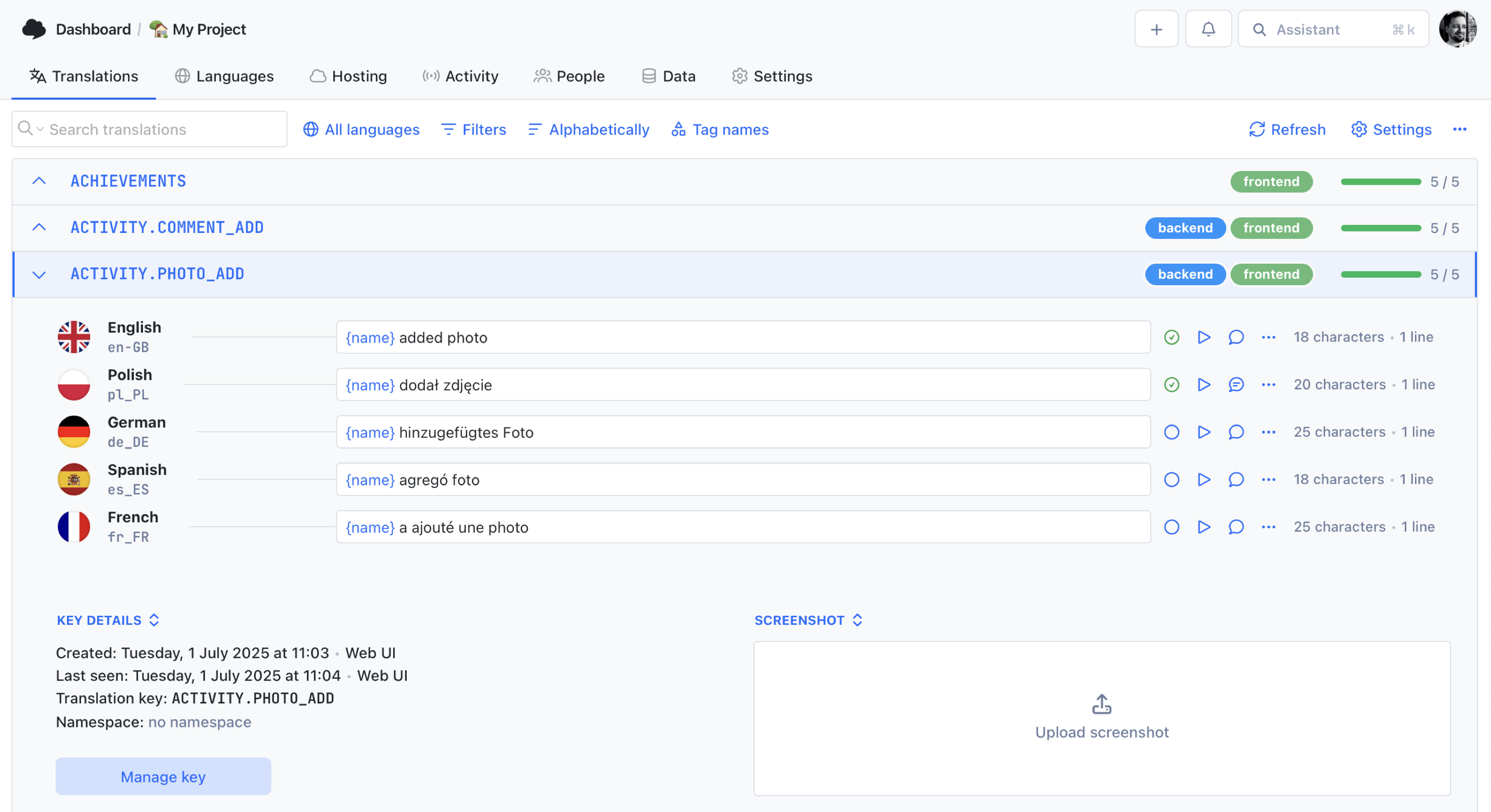
Smartcat is heavily integrated with its freelancer marketplace. If your team already has translators or uses AI exclusively, the marketplace-heavy UI can feel cluttered and distracting. SimpleLocalize gives you a clean, focused interface: no marketplace prompts, no freelancer management, no noise.
Your translators, your way
Invite your own team members or translators directly. No middlemen, no per-word platform fees, no marketplace lock-in.
AI-first, not marketplace-first
Use OpenAI, DeepL, Google Translate or custom AI models for auto-translation. No need to navigate around a marketplace you'll never use.
Clean, focused editor
SimpleLocalize's UI is built for editing translations, not managing freelancer workflows. Search, edit, and ship, that's it.
Built for developers,
not project managers
If you manage translations like you manage code, with Git, a CLI, and CI/CD, SimpleLocalize fits right into your workflow. Smartcat's developer tooling exists, but the platform was designed around human workflow orchestration, not developer pipelines.
CLI that fits your pipeline
Push and pull translations from your terminal. Open-source CLI built for CI/CD. Sync JSON, YAML, XLIFF, and more, directly from your repo.
GitHub, GitLab, Bitbucket
Native integrations with your Git provider. GitHub App, GitHub Actions, and webhooks, translations sync automatically with every push.
REST API & MCP Server
Full REST API for everything. Plus a full-featured MCP Server so AI agents can manage keys, translations, tags, and languages, on every plan.
Predictable pricing
vs. $1,200/year starting cost
Smartcat's pricing starts around $1,200/year for the Basic plan. That's a big jump for a startup that just needs to sync some JSON files. SimpleLocalize offers flat, transparent tiers, so you know exactly what you're paying before you sign up.
Startup
1,000 keys · 5 team members · 3 languages
CLI · API · CDN · AI translations included
1 collaborative space · No marketplace
Growing SaaS
Most common4,000 keys · 10 team members · 10 languages
25 members · Automations · Permissions
Contact sales · Unlimited collaborative spaces
Scale-up
12,000 keys · 30 team members · 20 languages
100 members · SAML SSO · All features
SSO · MSA · Audit logging
Pricing verified: April 2026. SimpleLocalize pricing is publicly available. Smartcat Basic plan starts at $1,200/year. Enterprise pricing requires contacting sales.
Not sure which platform fits your team?
Tell us about your project and we'll help you decide if SimpleLocalize is the right fit. No sales pitch, just honest advice.
Contact us →Why developers switch
from Smartcat
Smartcat is a powerful platform, but it's not built for the way developers work. Here's what teams tell us when they make the switch.
"Too complex for what we need"
Smartcat's marketplace, workflow orchestration, and enterprise features are overkill for a dev team that just wants to sync translation files and auto-translate missing keys. SimpleLocalize does exactly that, nothing more, nothing less.
"The pricing jump is hard to justify"
At $1,200/year for the Basic plan, Smartcat is a significant investment for a small team. SimpleLocalize starts at $15/month with no annual commitment — that's less than a month of Smartcat's cheapest plan for an entire year.
"We don't need a translator marketplace"
Smartcat's core value proposition is its freelancer marketplace and managed translation services. If you use AI translation or have your own translators, you're paying for a feature you'll never touch.
"We want Git-style translation management"
Developers want to push and pull translations from a CLI, sync with GitHub, and automate everything via CI/CD. SimpleLocalize was built for this workflow. Smartcat was built around managing human translators.

"Super EASY to use, great documentation to connect through API.
Very nice dashboard to manage translators and their work.
I personally really do like the export/import of Excel files
where I can update translations key en masse"


Migration guide
From Smartcat to SimpleLocalize
in 3 simple steps
Switching from Smartcat is straightforward. Export your translations, import them, and update your integrations.
Export translations
Download your translation files from Smartcat in JSON, XLIFF, YAML, or any supported format.
Import into SimpleLocalize
Upload your files to SimpleLocalize using the web interface, REST API, or CLI. All common formats are supported, it takes minutes.
Update your integrations
Point your CI/CD pipeline to SimpleLocalize. REST API, CLI, webhooks, GitHub Actions, and translation hosting CDN are all available on every plan.
For a step-by-step walkthrough, see the getting started guide.
Real feedback
What customers love
about SimpleLocalize.
“It's simple, is the only tool that covers all of our needs, is reasonable in cost and fits into our workflow.”
“The simplicity.”
“It really is the simplest and fastest option on the market to get started with localization. We sent .json files back and forth with marketing to begin with, but now they can directly edit the copies in a nice interface and it reduces the overhead for developers.”
“Ease of access and good developer support.”
“It's pretty neat.”
“Brilliant work, well done. Been using it for about a year, and have enjoyed all the progress and continuous improvement I've seen since then.”
“Purrfect.”
“I love everything! All the ways I can manage all my translation strings!”
“Lots of (useful) features, little what we don't need. Good focus on flexibility and integrations. Responsive developer.”
“It's smart.”
“Simple interface. Meets localization needs. All developers can use it, with no per seat cost. Good value service. Responsive support.”
“It's simple to use compared to other platforms we used in the past.”
“UI”
“It's literally very simple to use and has sane pricing!”
“Features and superb support”
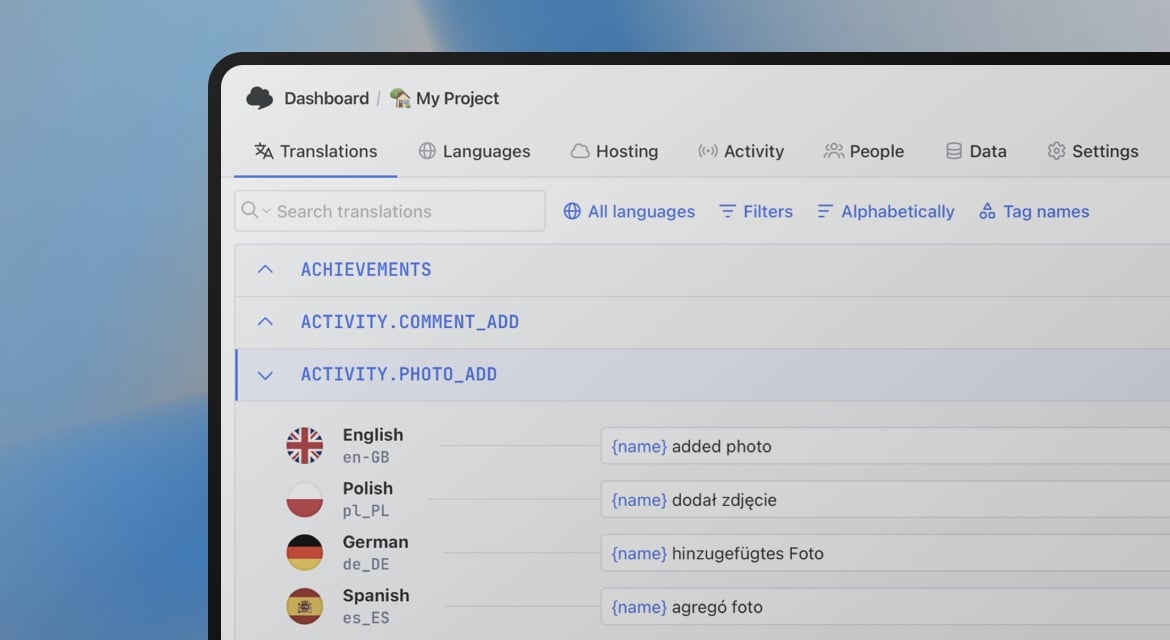
Ship translations without the overhead
- Self-serve setup in 5 minutes, no complex onboarding
- Transparent pricing from $15/mo, no annual commitment required
- CLI, REST API, GitHub, and Figma included on every plan
- AI-powered auto-translation with OpenAI, DeepL, and Google Translate
- No marketplace noise, just a clean editor for your translations
- Vendor agnostic: bring your own translators, no per-word fees
"The product
and support
are fantastic."
"The support is
blazing fast,
thank you Jakub!"
"Interface that
makes any dev
feel at home!"
"Excellent app,
saves my time
and money"
Resources
See the latest news from our blog, including product updates, tutorials, and more.
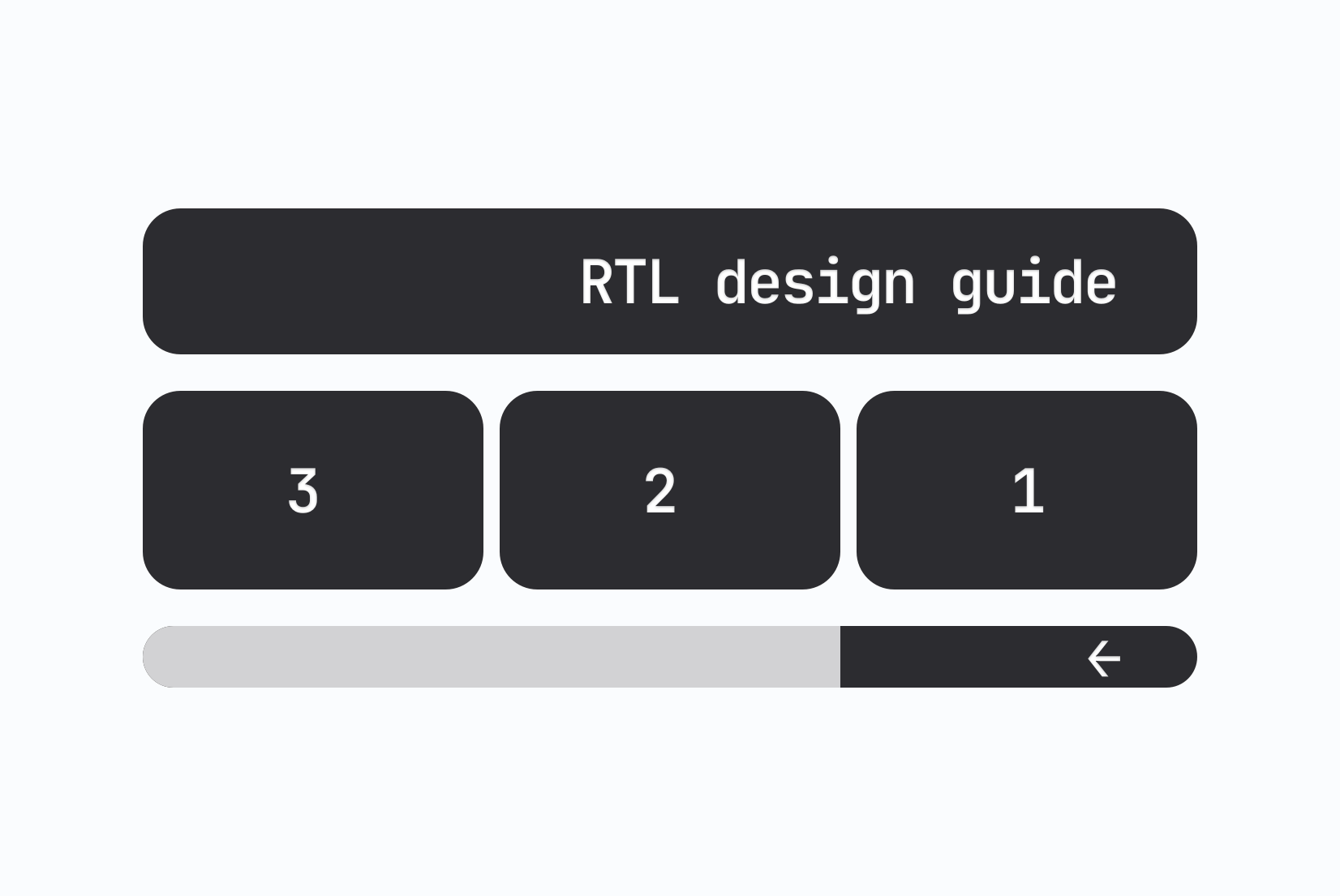
RTL design guide for developers: Bidirectional layout done right
A practical RTL design guide for developers. Learn how to implement right-to-left layouts for Arabic, Hebrew, and Persian, with real CSS examples, common mistakes, and a hotel booking UI walkthrough.
Xcode String Catalog (.xcstrings): The complete guide for iOS localization
Everything developers need to know about .xcstrings string catalogs. Covers JSON schema, extractionState and translationState flags, pluralization, device variants, universal placeholders, Git merge conflict strategies, Xcode 26 AI comments, and SimpleLocalize integration.
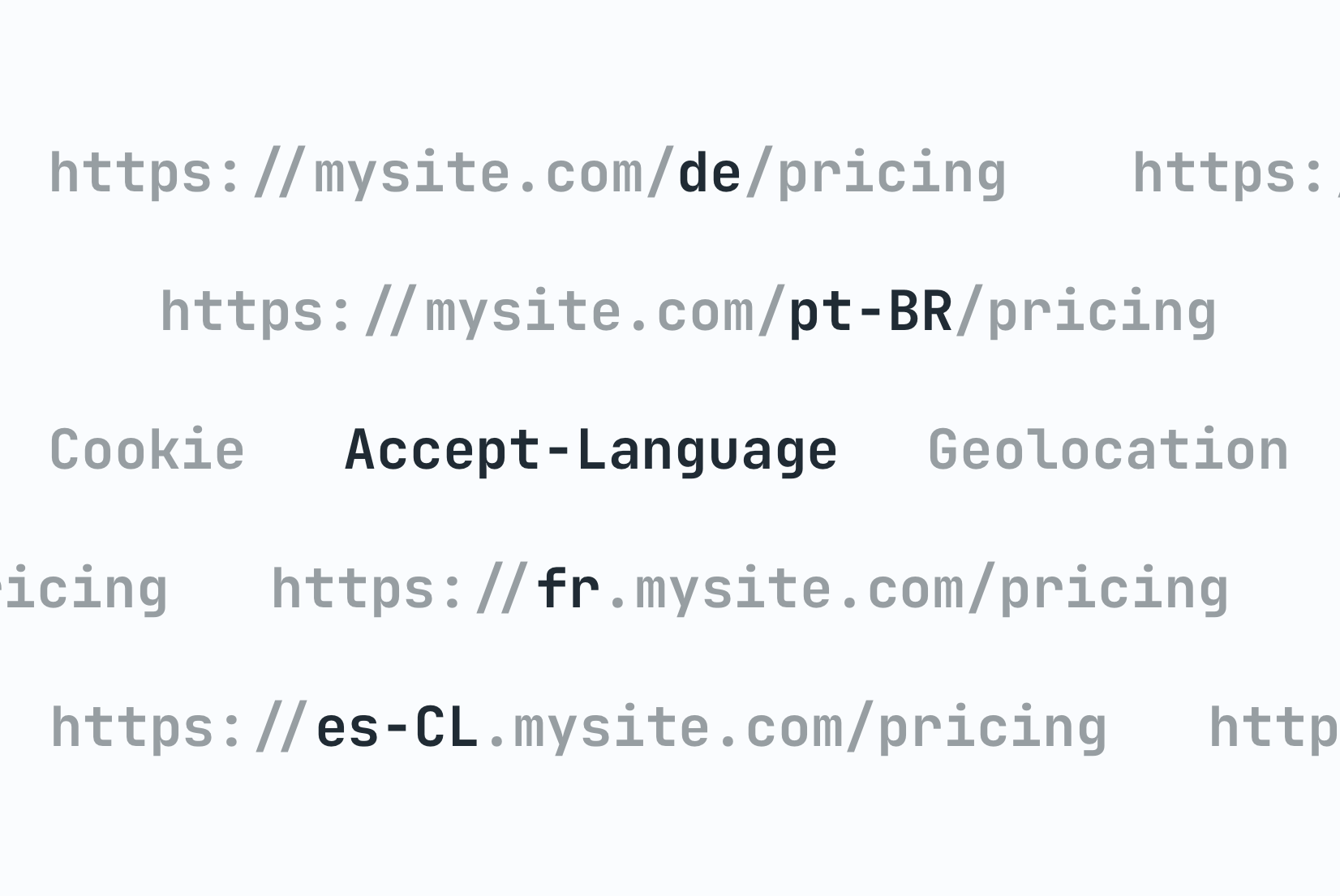
Locale detection strategies: URL, Cookie, or Header?
Compare locale detection strategies with code examples. Learn the trade-offs of URL paths, cookies, and headers with an architectural decision framework.
Pre-translation checklist: What to prepare before every translation cycle
A practical pre-translation checklist for dev and product teams. What to audit, prepare, and confirm before sending strings to translation, so you translate once and ship right.

Vue.js i18n: The complete guide to localizing Vue and Nuxt apps
Learn how to internationalize and localize Vue 3 and Nuxt apps with vue-i18n. Covers setup, translation files, pluralization, locale detection, lazy loading, CI/CD integration, and SimpleLocalize workflows.
Is SimpleLocalize a good alternative to Smartcat?
Yes. SimpleLocalize is a developer-first alternative to Smartcat. It offers transparent pricing from $15/mo, a powerful CLI, CI/CD integrations, and AI-powered auto-translation on every plan. If you're a developer or SaaS team that doesn't need Smartcat's freelancer marketplace, SimpleLocalize is a leaner, more affordable choice.
How does SimpleLocalize pricing compare to Smartcat?
SimpleLocalize starts at $15/mo (Developer plan) with monthly billing. Smartcat's Basic plan starts at $1,200/year (~$100/mo) and only includes 1 collaborative space with no marketplace access. SimpleLocalize includes unlimited languages, CLI, API, CDN, and AI translations on every paid plan. For teams that don't need Smartcat's marketplace or enterprise compliance features, SimpleLocalize is significantly more affordable.
Can I migrate from Smartcat to SimpleLocalize?
Absolutely. Export your translation files from Smartcat in JSON, XLIFF, YAML, or any supported format, then import them into SimpleLocalize via the web interface, REST API, or CLI. The migration typically takes minutes for small projects.
What is Smartcat's marketplace and do I need it?
Smartcat includes a built-in marketplace where you can hire freelance translators and language service providers. If your team already uses AI translation (OpenAI, DeepL, Google Translate) or has its own translators, you don't need the marketplace — and you'd be paying for a feature you won't use. SimpleLocalize is vendor agnostic and doesn't include a marketplace, keeping the interface clean and focused.
Is Smartcat too complex for small dev teams?
That depends on your workflow. Smartcat is built for project managers and LSPs who need to orchestrate human translation workflows at scale. For a developer who just needs to sync JSON files, auto-translate missing keys, and push translations via CI/CD, Smartcat's complexity can feel like overhead. SimpleLocalize was designed specifically for this developer-centric workflow.
Does SimpleLocalize have a CLI like Smartcat?
Yes. SimpleLocalize has an open-source CLI that works on all plans, including the free Community plan. It supports pushing and pulling translations in all major file formats (JSON, YAML, XLIFF, ARB, and more) and integrates natively with CI/CD pipelines like GitHub Actions, GitLab CI, and Bitbucket Pipelines.
Does SimpleLocalize support the same file formats as Smartcat?
Yes. SimpleLocalize supports all major file formats including JSON, YAML, XLIFF, ARB, Android XML, iOS Strings, Properties, CSV, Excel, and more. Both platforms support standard i18n formats used in modern software development.
Why Choose SimpleLocalize Over Smartcat
SimpleLocalize is a Smartcat alternative built for developers and SaaS teams that want to ship translations fast — without marketplace noise, enterprise-heavy pricing, or workflow complexity designed for language service providers. Key benefits:
- Developer-first: CLI, REST API, GitHub integration, Figma plugin, and MCP Server on every plan
- Transparent pricing from $15/mo, no $1,200/year minimum, no annual commitment required
- No marketplace noise: clean UI focused on editing and shipping translations
- AI-powered auto-translation with OpenAI, DeepL, and Google Translate
- Vendor agnostic: bring your own translators without per-word platform fees
- Native CDN hosting: no proxy, no broken layouts
Smartcat's marketplace-first approach vs. SimpleLocalize's developer-first approach
Smartcat was built around its freelancer marketplace and managed translation services. The platform excels at connecting businesses with human translators, managing translation workflows, and scaling language service operations. SimpleLocalize takes the opposite approach: it's a continuous localization tool built for developers who want to manage translations like code. Push keys via CLI, auto-translate with AI, sync with GitHub, and deploy via CDN. No marketplace, no middlemen, no complexity you don't need.
Pricing: flat tiers vs. enterprise-heavy model
SimpleLocalize publishes all pricing on its website: Community (free), Developer ($15/mo), Team ($39/mo), and Business ($129/mo). Monthly billing is available, no annual commitment required. Smartcat's Basic plan starts at $1,200/year with limited features (1 collaborative space, no marketplace access, standard support). The Enterprise plan requires contacting sales for custom pricing. For startups and growing SaaS teams, SimpleLocalize offers the core capabilities at a fraction of the cost.
Developer experience comparison
SimpleLocalize includes CLI, REST API, webhooks, Figma plugin, GitHub App, VS Code extension, IntelliJ plugin, and a full-featured MCP Server on every plan — including the free plan. Smartcat offers API access and integrations, but the platform is designed primarily around project manager workflows and human translator coordination. For teams that want a Git-style approach to translation management, SimpleLocalize is the better fit.
When to choose Smartcat over SimpleLocalize
Smartcat is the better choice if you need a built-in marketplace of freelance translators, enterprise compliance features (SSO, MSA, audit logging), or you're a language service provider managing multiple client projects. If your primary workflow is dev-driven — syncing files, automating translations, and deploying via CI/CD — SimpleLocalize is the more focused, more affordable option.