10 localization myths that hurt growth (and what to believe instead)


Localization myths are dangerous precisely because most of them sound reasonable.
"Our users all speak English". "We'll localize once the product is stable". "Machine translation is good enough for now". None of these statements are obviously wrong, which is exactly why they persist, and why they cost SaaS teams real money.
This post breaks down ten of the most common localization myths, what they get wrong, and what a more accurate belief looks like in practice.
Myth 1: "Our users speak English, so we don't need localization"
This is the most common myth, and the most expensive one to hold for too long.
The assumption is that because your current users speak English, your potential users do too. But current users are a biased sample: they found your product despite the language barrier, not because of it.
Consider the actual numbers: roughly 75% of internet users are non-native English speakers, and studies consistently show that people are more likely to buy when addressed in their own language. The CSA Research "Can't Read, Won't Buy" report, which surveyed thousands of online shoppers across markets, found that a majority preferred buying in their native language, even when they spoke English well.
What to believe instead: Your current user base reflects who found you despite the friction of an English-only product. Localization removes that friction. The question isn't whether non-English users exist; it's how many of them you're currently losing.
Related: 10 strategic benefits of localizing your app (beyond just more users)
Myth 2: "Localization = translation"
This is the myth that turns good intentions into poor execution. Teams budget for "translation," do the translation, and then wonder why international users still churn.
Translation is converting text from one language to another. Localization is adapting the entire product experience for a target market: date formats, currency symbols, right-to-left layout, culturally appropriate imagery, legal compliance, tone of voice, and UX conventions that differ by region.
A German user who sees a page that says "Save changes" correctly translated as "Änderungen speichern" but still shows prices formatted as $1,234.56 instead of 1.234,56 € is looking at a partially localized product. It signals that the team did the minimum.
Some of the most costly localization failures aren't about wrong words, they're about wrong formats, wrong symbols, or wrong cultural assumptions that slipped through because the team thought "translation" and "localization" were the same thing.
What to believe instead: Translation is one input into localization. A complete localization effort also covers formatting, layout, cultural fit, legal requirements, and UX patterns. For a clear breakdown of where the lines are, see Localization vs Internationalization vs Translation.
Related: Translation vs localization: Key differences, examples, and when to use each
Myth 3: "We'll localize once the product is stable"
This sounds like disciplined prioritization. In practice, it's procrastination with strategic-sounding justification.
The problem is that "stable" is a moving target. Products are never truly finished, and the longer you wait to internationalize the codebase, the more expensive it becomes. Retrofitting i18n into an existing product means touching every component, every date and currency format, every hardcoded string, every layout assumption baked in around English text length.
Example: A SaaS team delayed i18n for two years while iterating on their core product. When they finally decided to go multilingual, they discovered over 1,200 hardcoded strings spread across 80+ components, dates formatted as US strings throughout the backend, a UI designed with no accommodation for text expansion, and routing with no concept of locale. The retrofit took a full quarter of engineering time. A proper i18n setup from the start would have cost days, not months.
Shipping in one language is perfectly fine. But using translation keys and locale-aware formatting from day one, even when you only support English, costs almost nothing and avoids an expensive future overhaul.
What to believe instead: Internationalization (i18n) should happen early, even before you add a second language. Localization (the actual content and market adaptation) can happen later when the demand is clear. The technical foundation is cheap to build now and expensive to retrofit later.
Related: What is internationalization (i18n)? | Why retrofitting i18n is expensive
Myth 4: "Machine translation is good enough"
For some content, in some contexts, machine translation is excellent. For many others, it produces results that range from slightly awkward to brand-damaging.
The "good enough" myth usually collapses in one of three ways:
-
False cognates and ambiguity.
The classic example: a UI button labeled "Home" could mean a house, a navigation destination, or a home screen. Without context, MT engines guess, and they guess wrong regularly. German "Haus" (building) vs. "Startseite" (navigation home) is a translation decision that depends entirely on context the MT engine doesn't have. -
Tone mismatch.
MT doesn't know whether your product addresses users formally or informally, uses industry-specific terminology, or has a brand voice that leans playful. A formal MT output for a consumer app aimed at Gen Z reads like a government document. -
Layout-breaking output.
MT will faithfully translate a 20-character English string into a 45-character German equivalent. Your UI, designed around the English version, breaks.
None of this means MT has no place. Baseline MT followed by human review is a legitimate and efficient workflow. MT as a cost-elimination strategy without any review process is a different thing entirely.
What to believe instead: Machine translation is a powerful first pass, not a final output. Context-aware AI translation with project-level and key-level context significantly outperforms raw MT. Combined with a structured review workflow, it's the right foundation, not the complete solution.
Related: AI vs MT: Auto-translation comparison with examples | ChatGPT and DeepL translation context in auto-translation
Myth 5: "Localization is a one-time project"
This myth is responsible for some of the most common localization failures: the initial launch goes fine, then translations drift out of sync as the product evolves, new features ship in English only, and the "localized" version slowly becomes a stale, partially-translated shadow of the real product.
Software is never done. New features get added, copy gets revised, onboarding flows change, pricing pages update. Every one of these changes creates a gap in your translations if localization is treated as a project rather than a process.
Teams who think of localization as one-time work end up doing one of two things: either they block product releases until translation is complete (slowing the whole team), or they ship untranslated content and quietly let the localized versions fall behind (frustrating international users).
What to believe instead: Localization is an ongoing workflow that runs in parallel with product development. Continuous localization (where new strings are automatically detected, translated, reviewed, and deployed as part of the CI/CD pipeline) is how mature teams solve this. The goal is making translation invisible to the release process, not a blocker.
Related: Continuous localization: What it is, why it matters, and how to implement it
Myth 6: "More languages = more growth"
Adding languages feels like progress. The logic seems sound: more languages reach more users, more users means more revenue. In reality, localization ROI is highly uneven across languages, and spreading thin across many languages often produces worse results than going deep on a few.
Languages with marginal user bases in your target market, limited willingness to pay, or misaligned product-market fit can absorb significant localization cost while producing little incremental revenue. Meanwhile, the languages that would move the needle get under-invested because the budget was spread across ten mediocre bets.
Example pattern: A SaaS team adds twelve languages because their competitors support twelve. Eight of those languages contribute less than 2% of total revenue combined. The localization overhead for those eight languages (ongoing maintenance, QA, updates with every release) quietly consumes a third of the localization budget while the two highest-value languages receive insufficient review quality.
Worse, poor-quality localization in a language often performs worse than no localization at all. Users in markets where the translation is obviously machine-generated, tonally off, or full of formatting errors will trust the product less than if it had simply been presented in English.
What to believe instead: Prioritize languages by market potential, user demand, and conversion data, not by the length of a list. Starting with two to five languages done well outperforms ten languages done poorly. See our guide on how to plan localization for your first five languages for a practical prioritization framework.
Related: Localization strategy for global SaaS growth | Scaling localization from 1 to 100 languages
Myth 7: "Localization is expensive"
This myth is partly true and partly a category error. It's true that localization can be expensive if it's done reactively, without proper i18n foundations, with manual workflows, and with no automation. It's not true that well-designed localization is inherently expensive.
The expensive version of localization looks like this: retrofit i18n into a mature codebase (weeks of engineering), manually export translation files and email them to an agency (days of coordination per cycle), manually re-import and test (more days), then do this again for every release.
The efficient version looks like: i18n built in from the start (minimal overhead), translations synced automatically via CLI and CI/CD, MT handles the first draft, a translator reviews only what changed, everything deploys with the regular release.
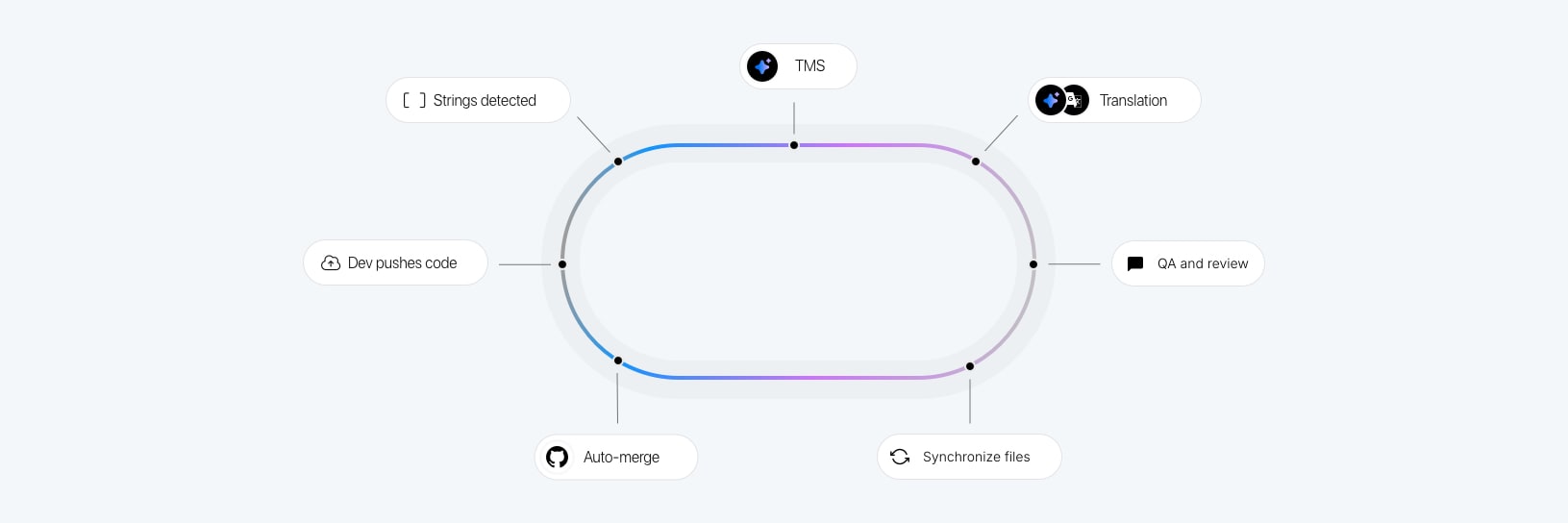
A continuous localization workflow reduces the per-language marginal cost to near zero once the pipeline is set up. The majority of the cost is in the initial setup, both technical (i18n foundation) and operational (workflow, tooling, team).
Tool selection also matters significantly here. Many teams overpay for translation management because they chose a TMS with word-based or language-tier pricing that scales faster than their product revenue. The right TMS pricing model should be predictable and tied to product size, not translation volume.
What to believe instead: Localization cost is largely a function of how it's designed, not an inherent property of the work. Teams that build the right technical and operational foundations spend far less per language over time than teams that treat each localization cycle as a new project.
Myth 8: "Someone on the team speaks the language, they can review translations"
This one surfaces frequently in early-stage companies and well-intentioned product teams. The intent is good: ensure quality by having a native speaker verify the output. The execution is usually flawed.
There are two distinct problems. First, language proficiency is not the same as localization expertise. A native German speaker on the engineering team can verify that a string is grammatically correct. They probably cannot tell you whether it matches your brand voice, uses the right formality register for your audience, follows German UI conventions, or applies domain-specific terminology consistently across the product.
Second, this creates an unscalable dependency. The native speaker becomes a bottleneck. They were hired to do a different job. Localization review is intermittent, inconsistent, and often deprioritized under deadline pressure.
This pattern shows up repeatedly in localization post-mortems: "We had someone who spoke French on the team, so we had them review the translations when they had time." The translations were grammatically fine and culturally off. Users in France noticed. Support tickets in French spiked after launch.
What to believe instead: Native language review is necessary but not sufficient. Structured QA workflows that include terminology checks, tone consistency, and UI fit should complement native review. For most teams, this means either working with professional localization reviewers or implementing systematic localization QA processes, not relying on whoever happens to speak the language.
Related: What is localization QA? Definition, benefits & best practices
Myth 9: "We'll figure out ownership later"
Localization involves product, engineering, marketing, and potentially a dedicated localization team. Without clear ownership, every stakeholder assumes someone else is handling it, and nothing gets handled.
The symptoms are recognizable: new features ship in English only because no one told the localization team. Translation files go stale because no one owns the extraction workflow. QA issues pile up because no one has authority to block a release over translation problems. Budget requests get rejected because no one has built the business case.
Localization without ownership erodes trust in the localized versions of the product over time. Users in non-English markets become accustomed to features appearing in English first, translations arriving weeks late, and occasional strings that clearly weren't reviewed. The product starts to feel like a second-class citizen in their market, which is often worse than not localizing at all.
What to believe instead: Define ownership before you start, not after a problem surfaces. Decide who owns the technical pipeline (usually engineering), who owns translation quality and language selection (product, marketing, or localization program manager), and how the two collaborate. For guidance on the boundary between i18n ownership and l10n ownership, see the internationalization guide.
Related: Localization maturity model: 5 stages of scalable global growth for SaaS | What is a localization workflow?
Myth 10: "If we build it well enough, localization will take care of itself"
This is the most optimistic myth and the most technically sophisticated one. It usually comes from developers who have implemented a clean i18n architecture and assume the rest will follow naturally.
The technical foundation is genuinely important. A well-structured i18n system with proper key management, namespace separation, locale-aware formatting, and CI/CD integration makes everything easier. But it doesn't replace strategy, workflow, or quality governance.
Localization that takes care of itself means:
- Translation keys accumulate without context, and translators guess what they mean
- MT drafts ship without review because no one set up a review process
- Languages drift in quality because no one monitors them after launch
- New markets never get prioritized because no one owns the language roadmap
- ROI is never measured because no one defined the metrics
The technical infrastructure enables the work. It doesn't do the work.
What to believe instead: Good i18n architecture is table stakes, not a strategy. The strategy layer (which markets to enter, how to staff and govern localization, how to measure ROI, how to integrate translation into the release cycle) requires explicit attention. The localization strategy guide covers this in full.
What these myths have in common
Looking at these ten myths together, a pattern emerges: they all underestimate localization as a discipline.
- Myths 1, 3, and 9 underestimate when localization matters and how early decisions compound.
- Myths 2, 4, and 8 underestimate the quality requirements of real-world localization.
- Myths 5 and 10 underestimate the ongoing nature of the work.
- Myths 6 and 7 underestimate the importance of strategy and design in making localization efficient.
In each case, the correction is not "localization is harder than you think". It's "localization is more designable than you think". The teams that do it well have made deliberate choices about i18n architecture, tooling, workflow, ownership, and measurement. The teams that struggle are the ones who made no choice at all, and then inherited the consequences.
If you're building a localization strategy from scratch, start with the Localization Readiness Checklist to evaluate where you stand across business, product, technology, and operations before you begin.
Related: 11 common localization mistakes (and how to avoid them) | Localization anti-patterns: What not to do early (and how to recover) | Best practices in software localization