Localization vs Internationalization vs Translation: Key differences for SaaS teams

If you're building or scaling a SaaS product globally, you've probably seen these three terms used interchangeably:
- Localization
- Internationalization (i18n)
- Translation
In early-stage teams, they're often treated as the same thing.
In scalable SaaS companies, they're treated as three distinct layers of product architecture.
Confusing them doesn't create a terminology problem.
It creates an execution problem, and eventually, technical debt.
Before building a structured localization strategy, you need to understand how these layers work together.
What is the difference between localization, internationalization, and translation?
Here's the short, operational version:
- Translation converts text from one language to another.
- Localization (l10n) adapts a product to a specific market or locale.
- Internationalization (i18n) prepares software to support multiple locales.
Translation changes words.
Localization adapts experiences.
Internationalization designs systems.
Quick comparison
| Aspect | Translation | Localization | Internationalization (i18n) |
|---|---|---|---|
| Focus | Text | Market adaptation | Infrastructure |
| Owned by | Translators / AI | Product + Marketing | Engineering |
| Happens when | After content exists | Before & during market launch | Before translation |
| Scope | Words & phrases | UX, formatting, legal, culture | Code architecture & formatting |
| Goal | Accuracy of meaning | User expectations | Scalability |
Understanding this separation is essential for SaaS scalability.
Translation = The content layer
Translation is the process of converting text between languages.
It lives in:
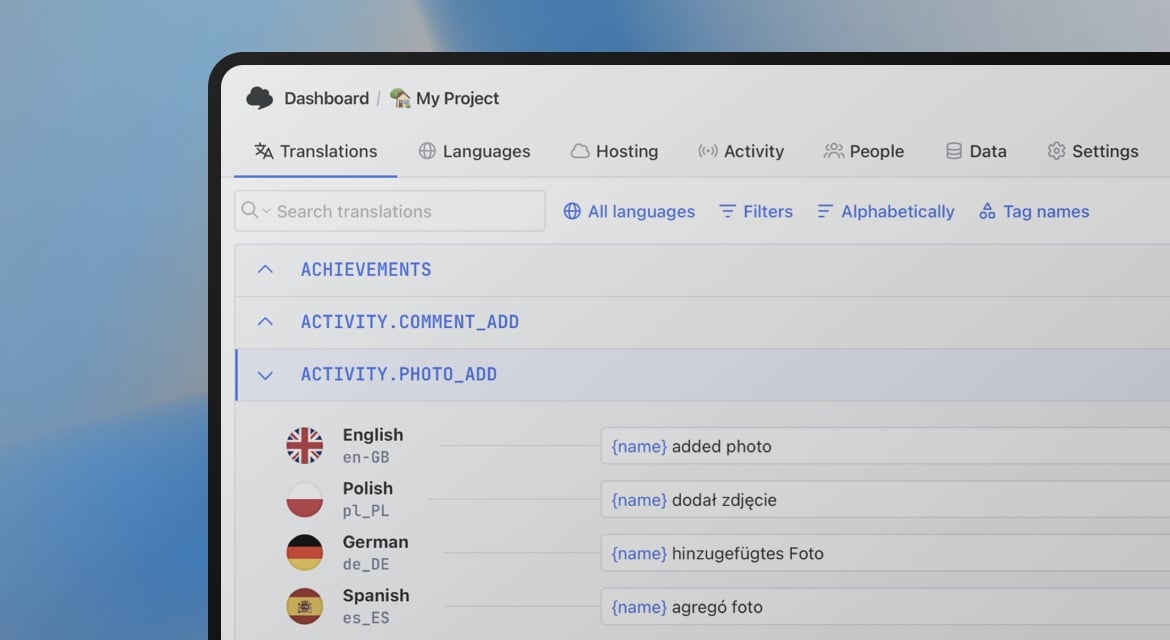
- Translation files (JSON, CSV, XLIFF, etc.)
- Translation management systems
- Marketing copy
- UI labels
- Documentation
Translation is about meaning.
Example:
"Your subscription renews tomorrow."
A translator ensures the sentence is grammatically correct and contextually accurate in another language.
But translation alone does not adapt formatting, currencies, logic, or UX.
Learn more in our detailed guide on the difference between translation and localization.
Localization = The market adaptation layer
Localization includes translation, but goes far beyond it.
It adapts your product to local expectations, including:
- Currency formatting
- Date and time formats
- Measurement units
- Tone of voice
- Legal disclaimers
- Cultural references
- Payment preferences
Localization is about user expectations, not just language.
A SaaS dashboard that is translated but still shows US date formats in Germany is readable, but not localized.
Localization ensures the experience feels native.
Internationalization (i18n) = The infrastructure layer
Internationalization (often abbreviated as i18n) happens before localization.
It is the architectural work that allows your product to support multiple locales without rewriting code for each one.
i18n includes:
- Externalizing all strings
- Supporting plural rules
- Handling variable-length text
- Locale-aware formatting
- Dynamic currency handling
- RTL (right-to-left) layout support
- Translation automation workflows
i18n is about system design.
If translation is content and localization is adaptation, internationalization is the foundation that makes both scalable.
Learn more in our guide to internationalization (i18n).
Why this distinction matters in SaaS
In SaaS, everything is dynamic:
- Subscription dates
- Usage limits
- Invoices
- Discounts
- Emails
- Dashboard metrics
- Pricing pages
If your system isn't properly internationalized, localization becomes manual and error-prone.
If localization isn't handled correctly, translation feels disconnected from business logic.
And if you treat translation as localization, you ship culturally awkward or technically broken experiences.
In subscription-based SaaS, pricing logic, invoicing, and compliance rules are dynamic. If localization is treated as static text translation, business logic and language quickly diverge, increasing QA load and slowing releases.
This is not a linguistic issue.
It's an architectural decision issue.
Practical example: A SaaS billing dashboard
Let's use a realistic example:
"Your subscription renews on 03/15/2026 at 5:00 PM. The monthly price is $49.99. You've saved 10% this year."
Now let's apply the three layers.
Translation only
Spanish translation:
"Tu suscripción se renueva el 03/15/2026 a las 5:00 PM. El precio mensual es $49.99. Has ahorrado 10% este año."
Grammatically correct. But not localized.
Problems:
- US date format
- 12-hour time format
- Dollar currency
- Incorrect decimal separator
- Incorrect percent spacing
- "PM" usage
Translation alone cannot solve these.
Proper localization
Localized for Spain (es_ES):
"Tu suscripción se renueva el 15/03/2026 a las 17:00. El precio mensual es 49,99 €. Has ahorrado un 10 % este año."
Changes include:
- Date format adjusted to DD/MM/YYYY (
03/15/2026→15/03/2026) - 24-hour time format (
5:00 PM→17:00) - Currency converted (
$49.99→49,99 €) - Decimal separator changed (
49.99→49,99) - Percentage spacing adjusted (
10%→10 %)
This is localization.
Internationalization (i18n) support
If your code looks like this:
"Your subscription renews on 03/15/2026 at 5:00 PM"
"The monthly price is $49.99"
"You've saved 10% this year"
You're locked into one locale.
Instead, with proper i18n:
"Your subscription renews on {renewalDate} at {renewalTime}"
"The monthly price is {price}"
"You've saved {discount} this year"
Then formatting becomes dynamic:
- formatDate(date, locale)
- formatTime(time, locale)
- formatCurrency(amount, locale)
- formatPercent(value, locale)
Now:
- en_US:
$49.99,03/15/2026,5:00 PM,10% - es_ES:
49,99 €,15/03/2026,17:00,10 %
The translation file stays clean. The formatting logic adapts automatically.
That's internationalization done right.
Where SaaS teams go wrong
Mistake 1: Hardcoding business logic into strings
"You've saved 10% this year"
Instead of:
"You've saved {discount} this year"
Hardcoded numbers break automation and scalability.
Mistake 2: Mixing localization into translation files
Developers manually rewrite strings per market instead of using locale-aware formatting utilities.
This leads to:
- Duplicate strings
- Inconsistent formatting
- Manual QA
- Slower releases
See also: Common localization mistakes.
Mistake 3: Postponing i18n
Retrofitting i18n into a mature SaaS product often means:
- Refactoring core components
- Reworking date handling
- Redesigning UI layouts
- Fixing overflow bugs
- Increasing regression risk
Internationalization is cheapest when implemented early.
If you're unsure whether your product is prepared, use our Localization Readiness Checklist.
How this fits into a localization strategy
A scalable localization strategy clearly separates responsibilities:
| Layer | Responsibility | Focus |
|---|---|---|
| Internationalization (i18n) | Engineering | Infrastructure |
| Localization (l10n) | Product + Marketing | Market adaptation |
| Translation | Linguists / AI | Language accuracy |
When these roles blur, scaling slows down.
When they're defined, adding a new language becomes operational, not chaotic.
Learn how to structure this properly in our Ultimate Guide to Localization Strategy.
The bigger picture: growth, not just language
Global expansion isn't about speaking another language. It's about:
- Displaying prices correctly
- Sending compliant invoices
- Respecting cultural expectations
- Maintaining brand voice
- Scaling releases predictably
Translation makes your product readable.
Localization makes it relatable.
Internationalization makes it scalable.
Conclusion
Understanding the difference between localization, internationalization (i18n), and translation isn't academic.
It's operational.
It impacts:
- Engineering effort
- Release speed
- Technical debt
- QA load
- User trust
- Market expansion
SaaS teams that treat these as three distinct architectural layers scale languages predictably instead of reactively.
Build i18n early.
Treat translation as structured data.
Design localization as a product decision, not a last-minute task.