Convert YAML to JSON online
Upload a YAML file and download it as JSON. Translation keys, plurals and placeholders are preserved. Free, no account needed.
Pick the source format or let the converter detect it from the file.
Used when the source format holds one language per file. Also used as the source language for XLIFF output.
Choose the format you want to download.
A flat or nested key-value JSON file with translations for one language. It is the most common format for web and mobile apps because every language can parse it and it maps directly to the way i18n libraries look up strings.
Need it the other way round? Convert JSON to YAML.
From: YAML
YAML translation files use indentation instead of braces, which makes them easy to read and diff. Ruby on Rails, Symfony and many static site generators keep their locale files in YAML.
Used by: Ruby on Rails, Symfony, Jekyll, Hugo. One language per file. Read the YAML format guide.
hello-world: Hello World!
nested:
  translation:
    key: Nested translation key
  other:
    translation:
      key:
supported: Look this is also supported!To: JSON
A flat or nested key-value JSON file with translations for one language. It is the most common format for web and mobile apps because every language can parse it and it maps directly to the way i18n libraries look up strings.
Used by: i18next, react-intl, vue-i18n, next-intl, Angular, Node.js. One language per file. Read the JSON format guide.
{
  "hello.world": "Hello World!",
  "my_address": "Address",
  "nested": {
    "translation": {
      "key": "nested translation key"
    }
  }
}
How to convert YAML to JSON
- Drop your .yml file into the converter above, or paste its content.
- Confirm the language of the file. It is guessed from the file name, for example
de.jsonormessages_pt-BR.properties. - Click Convert. You get one .json file per language.
- Preview the result, copy it or download the files.
What changes between YAML and JSON
- Keys are written flat by default. Enable "Write nested keys" to turn a.b.c into nested objects.
Convert and translate in one place
If you need the JSON file in more languages, the fastest route is a free SimpleLocalize project: import the YAML file, add languages, run auto-translation with DeepL, Google Translate, OpenAI, Claude or Gemini, and download the result as JSON. The CLI does the same from CI with upload and download commands, so the conversion becomes part of your build. See also translating YAML files.
Frequently asked questions
Is the converter free?
Yes. There is no signup and no limit on the number of conversions beyond a few requests per second.
Are my files stored?
No. The file is parsed in memory, converted and returned in the same request. Nothing is written to disk or a database.
What about plurals and placeholders?
Plural forms are normalized to ICU message syntax and written back in the native form of JSON. Placeholders are kept, and Apple and Android specific syntax is translated between platforms. Read more in the pluralization guide.
Convert YAML to other formats
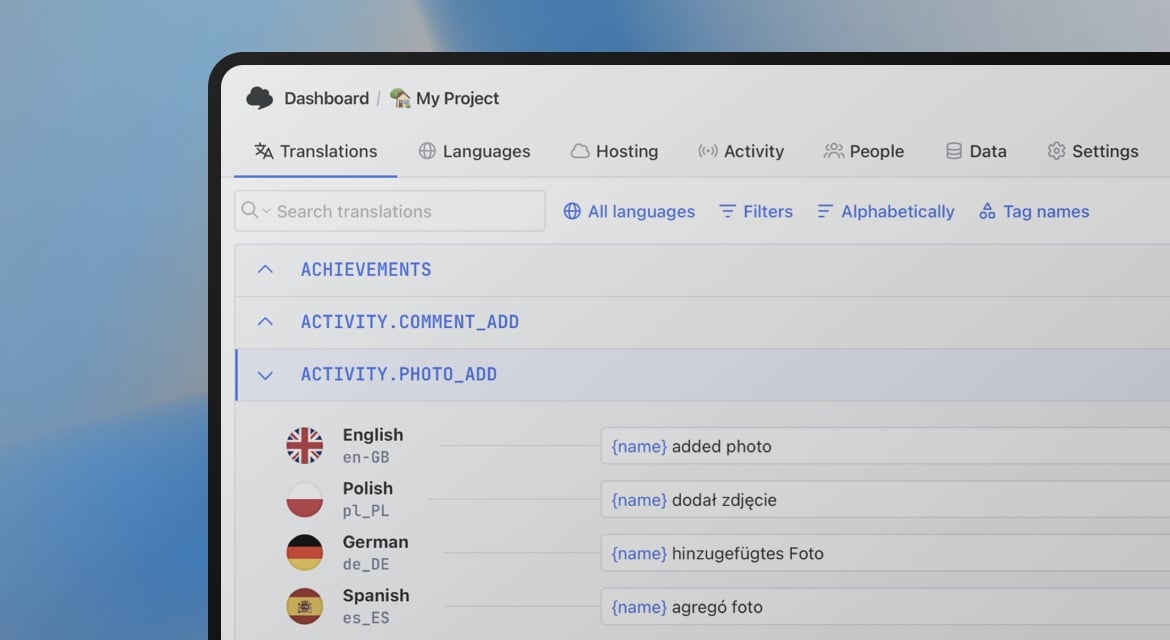
Translate your JSON files
- Import YAML or JSON files into a free project
- Auto-translate with DeepL, Google, OpenAI, Claude or Gemini
- Download in any of the supported formats or publish to the CDN