Does your app need multi-language support? 6 categories that almost always do

Not every app needs to support 12 languages on day one. But for many product categories, staying English-only isn't a neutral choice — it's actively leaving users behind.
This post walks through the categories of software where multi-language support has the highest impact, what signals to look for, and how to start without overbuilding.
If you've already decided to localize and want a step-by-step plan, see our Localization Strategy Guide for a full framework.
When does multi-language support actually matter?
A rough rule of thumb: if your product targets non-technical users, operates in a regulated domain, or competes in a global market, multi-language support is likely a competitive baseline not a differentiator.
Localization matters most when:
- Your potential users don't read English fluently enough to trust a product with their data, money, or workflow
- Competitors in target markets already offer native-language experiences
- Your acquisition or SEO strategy depends on non-English search traffic
- You're selling to businesses that operate in non-English environments
If none of those apply, localization can wait. If one or more do, the question isn't whether to localize, it's when and how.
6 app categories that almost always need multi-language support
1. Travel and hospitality apps
Travel is inherently cross-border. A traveler using a trip planner, booking tool, or city guide expects it to work in their language, not ask them to switch mental gears mid-journey.
Why localization is critical here:
- Users are often in unfamiliar environments and need clear, unambiguous copy
- Trust is high-stakes: bookings, payments, navigation
- Travel apps often rely on user-generated content that spans many languages
Real example:
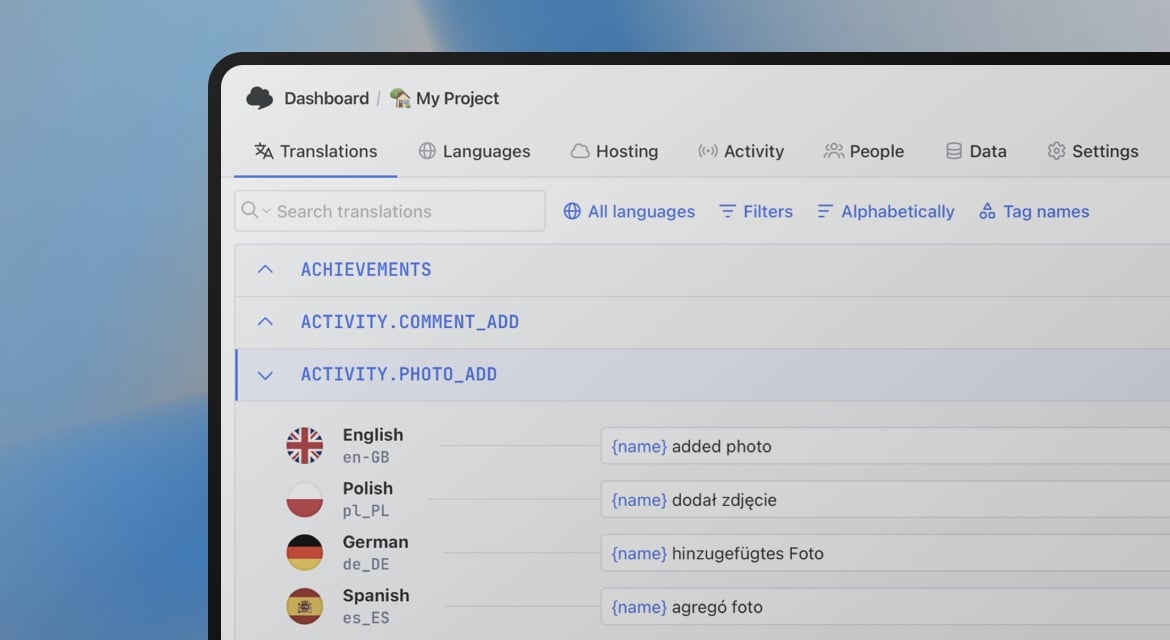
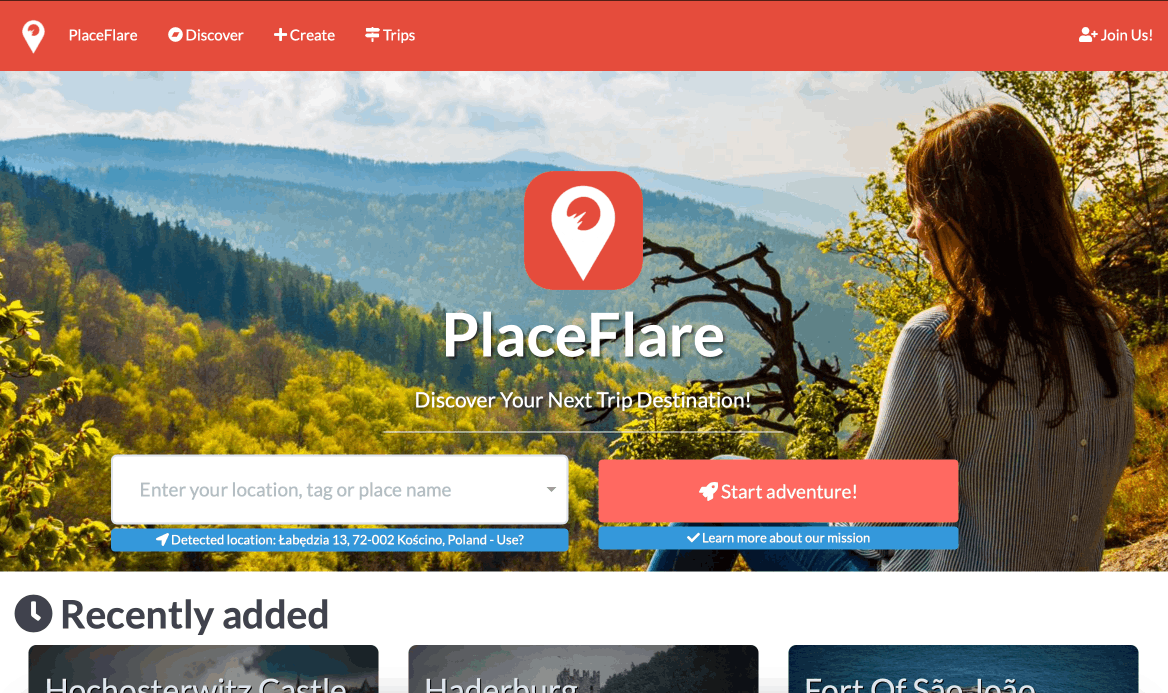
Our own side project, a hand-picked places app covering Italy, the UK, Spain, Czech Republic, and Poland, started with around 250 translation keys. Strings were extracted using the SimpleLocalize CLI, translated by native speakers in the SimpleLocalize Web Editor, and published without redeploying the app. Translations are fetched live from the SimpleLocalize CDN.
That kind of low-friction publishing matters for travel apps, where content changes frequently and waiting for a deployment cycle to fix a mistranslated button is not an option.
Signals you need localization:
Users drop off at booking confirmation steps, support tickets come in from non-English markets, or your analytics show significant traffic from regions you don't officially support.
2. eCommerce and marketplaces
Purchasing decisions are trust-sensitive. If a buyer isn't confident they understand the return policy, shipping details, or product description, they will leave — and usually won't come back.
Why localization is critical here:
- Product descriptions, checkout flows, and error messages need to be unambiguous
- Currency, date, and address formats must match local conventions
- Legal disclosures may require localization by law in some markets
Many successful online retailers actively disguise the fact that they're not local. When a shop feels native — right language, right formats, right tone — buyers are significantly more likely to complete a purchase. Large retail platforms often support 4 to 20+ languages for this reason.
What to localize first:
Checkout flow, product descriptions, error messages, email confirmations. These are the highest-friction surfaces. UI chrome and marketing copy can follow.
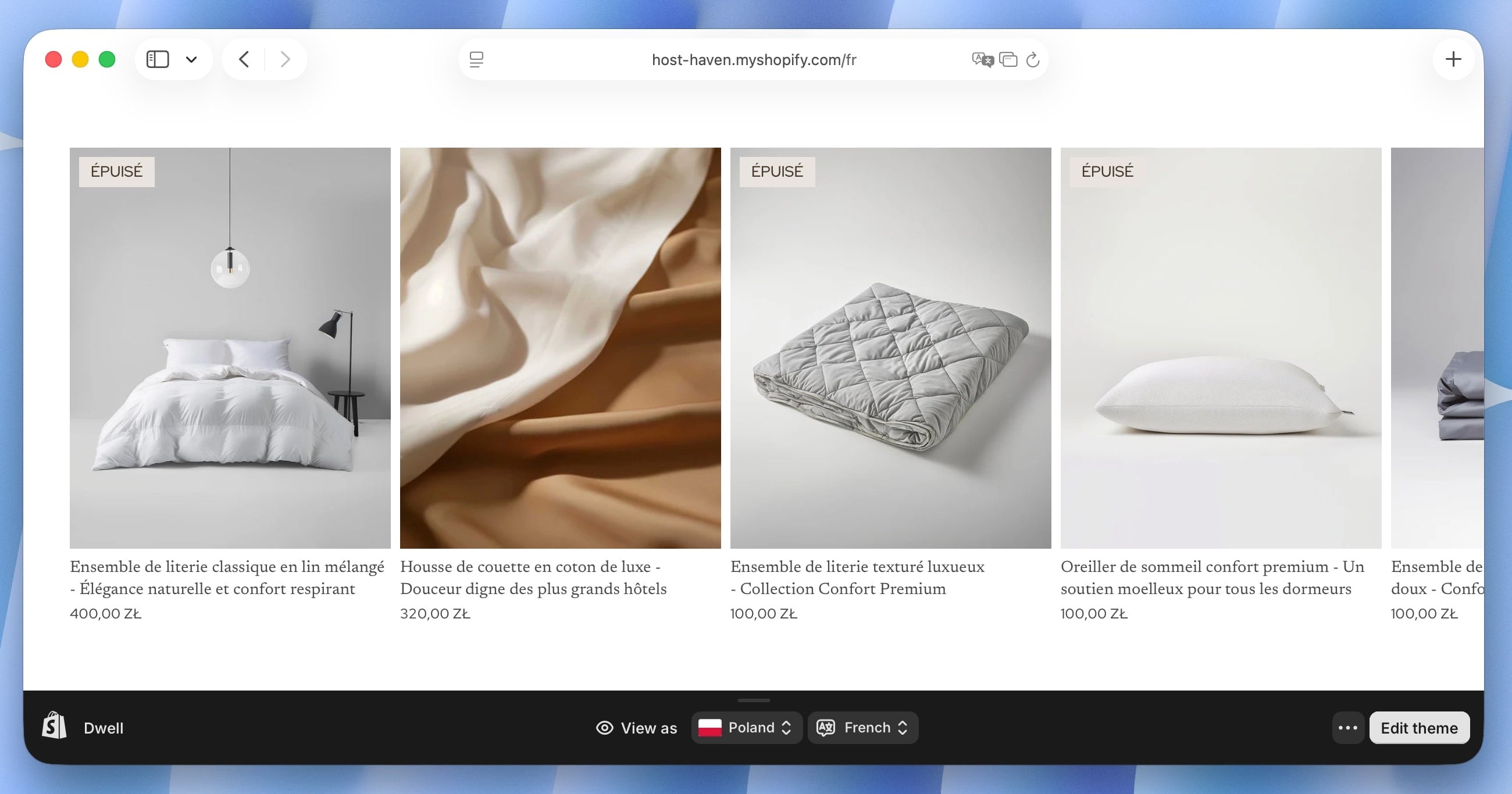
Check more information about eCommerce localization and how to manage product translations on Shopify.
3. SEO and marketing tools
Professionals who use SEO tools come from every country, and a significant share of them are not native English speakers. They can likely navigate basic UI, but they make better decisions and spend more time in a product that speaks their language.
Ahrefs is a useful benchmark: despite being a technical product used by professionals, the app supports 15 languages. That's not an accident. More languages means more organic search coverage, more word-of-mouth in non-English markets, and lower churn from users who would otherwise feel like second-class customers.
What makes localization high-ROI in this category:
- High customer lifetime value justifies the translation investment
- Non-English SEO professionals are a large, underserved audience
- In-product copy often explains complex concepts — precision matters
Signals you need localization:
Support tickets asking to explain features, users activating trials but not converting in certain markets, or keyword research showing non-English search volume for your core use case.
4. B2B SaaS and business tools
Enterprise and SMB buyers evaluate software rigorously. When a product's UI is in a foreign language, it raises questions: Is this company serious about our market? Will they support us if something goes wrong? Is the contract and compliance documentation available in our language?
Specialized vocabulary compounds this: an accounting term, a legal concept, or an HR workflow that's familiar in English can be completely opaque when poorly translated or left untranslated.
Starting point for most B2B SaaS:
English + French + German + Spanish + one Asian language (typically Japanese or Chinese, depending on market focus). This covers a large share of global enterprise decision-makers.
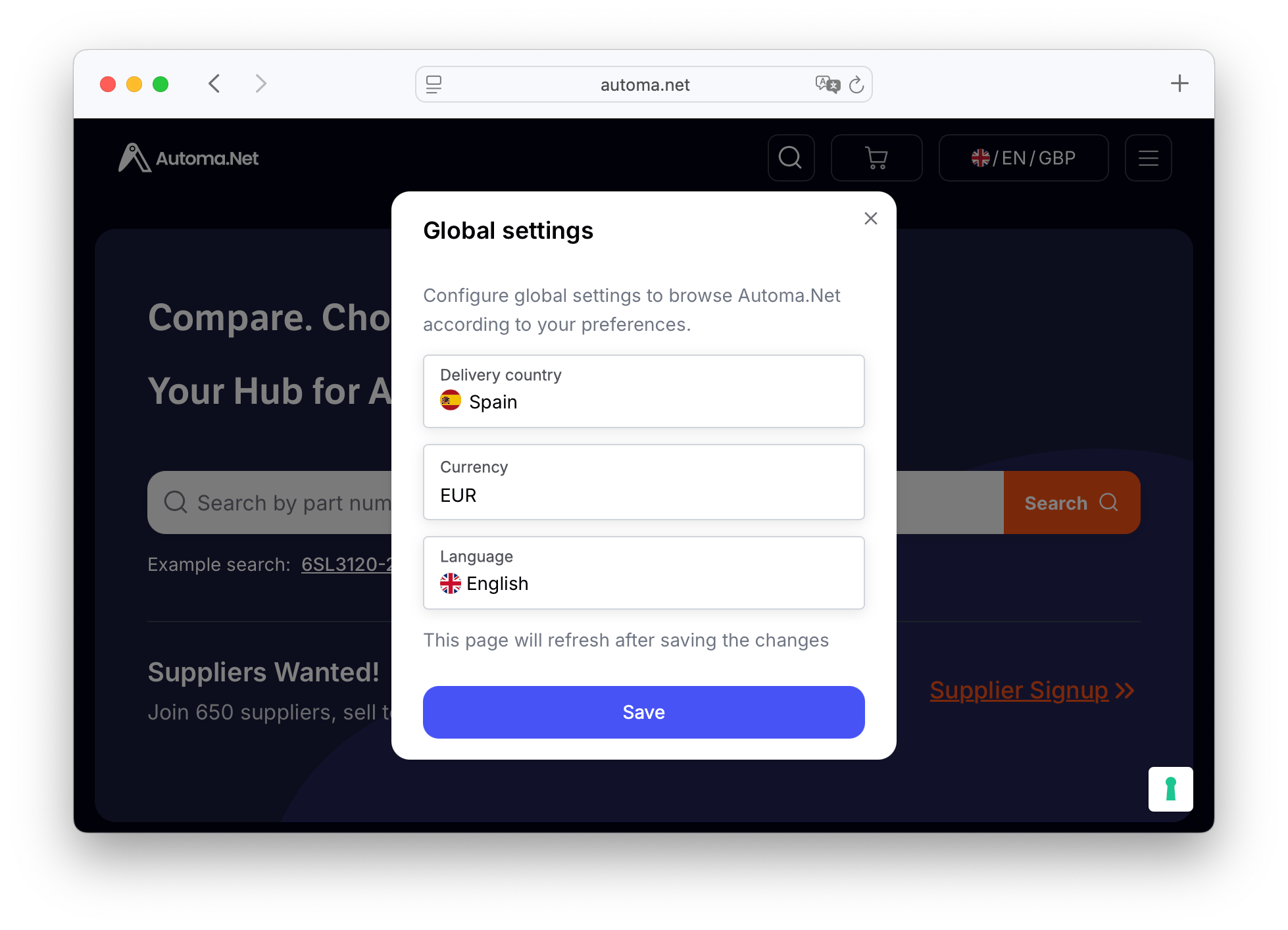
Many of our customers — like Automa.Net, which scaled to 18 languages, and Tasa.app, supporting 12 — are B2B products where localization directly reduced sales cycle friction and improved activation rates in new markets.
What to localize first:
Onboarding flows, dashboards, error states, and email notifications. These are where users spend the most time and where confusion causes churn.
Read more about benefits of localizing your app and Localization ROI framework
5. Finance, fintech, and legal platforms
This category has the highest localization stakes. Users are making decisions about money, legal agreements, and financial records. A mistranslation isn't a UX inconvenience, it's a liability.
Why localization is non-negotiable here:
- Users need to understand exactly what they're agreeing to
- Regulatory environments differ by country; copy often needs to match specific legal language
- Trust is the core product; native-language UI is table stakes for credibility
Fintech apps that operate across Europe, for example, often need to support all major EU languages to comply with consumer protection requirements and to pass app store review processes in some markets.
Localization note:
Finance and legal copy requires professional human translation with review cycles, machine translation alone is too risky.
6. Health, wellness, and consumer apps
Apps that people use to manage their health, track habits, or get mental wellness support operate in a highly personal context. The language needs to feel natural, warm, and accurate, at the same time.
A symptom tracker or medication reminder that uses the wrong register, or a wellness app that uses culturally off-tone phrasing, will feel wrong even if technically accurate. Users in this category are sensitive to nuance in a way that B2B users usually aren't.
What makes localization complex here:
- Tone and register matter more than in most product categories
- Medical and wellness terminology requires careful, consistent translation
- Cultural context shapes how health concepts are understood and discussed
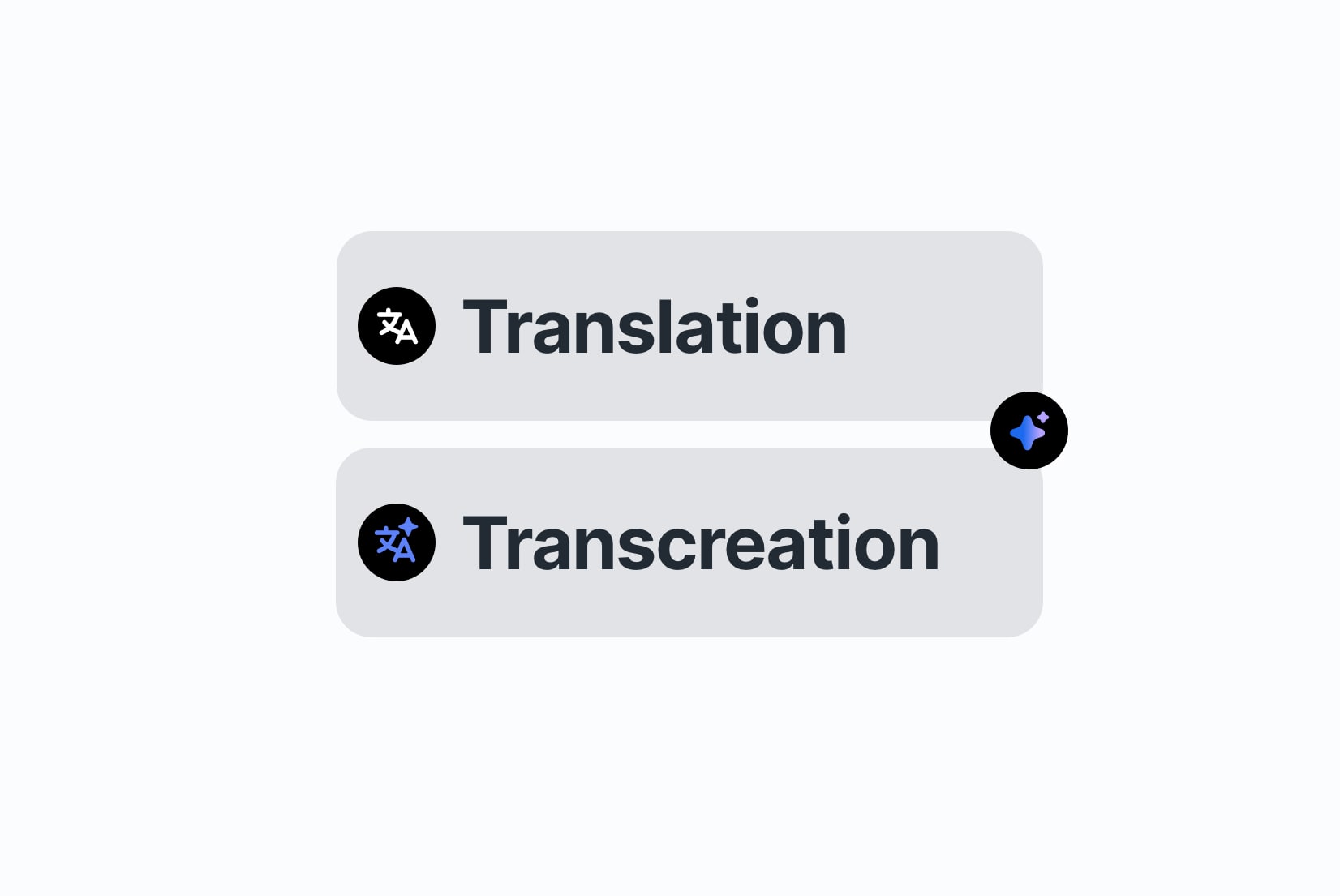
For consumer health apps in particular, transcreation, adapting meaning and tone rather than literal translation, is often more appropriate than standard translation.
How to decide if your specific app qualifies
Rather than fitting your product into a category, look at three signals:
- Where your users actually are. Check your analytics. If 15–30% of sessions come from non-English-speaking regions but your conversion rate there is significantly lower, localization is probably the gap.
- Where you're losing users. If your funnel analysis shows drop-offs at text-heavy steps (onboarding, checkout, forms), language friction is a likely cause.
- What your support queue looks like. A spike in support tickets from a specific country, or tickets asking to explain basic features, is a clear signal.
If you want a practical breakdown of these patterns, including what to ignore as noise, review our guide on timing signals.
Use the Localization Readiness Checklist to evaluate whether your team and product are ready to move forward with localization.
How to start without overbuilding
The most common mistake is waiting until localization feels urgent, by which point it's expensive to retrofit. The second most common mistake is doing too much too soon and wasting budget on languages that don't convert. Both are fueled by persistent myths about localization, like the belief that it's too expensive to start early, or that more languages automatically mean more growth.
A pragmatic path forward:
-
Step 1: Add i18n support now, even if you're only shipping one language.
Libraries like i18next for React or FormatJS let you externalize strings without requiring you to actually translate anything yet. This prevents the expensive retrofit later.
-
Step 2: Identify your highest-leverage language.
Usually this means looking at where you already have users or organic traffic, not where you'd theoretically like to expand. See how to plan your first 5 languages.
-
Step 3: Pick a workflow that matches your team size.
A solo developer can start with a lightweight TMS and basic CSV exports. A growing SaaS needs centralized translation management with review cycles. A mature product with CI/CD needs continuous localization. The localization maturity model breaks down what each stage looks like in practice.
-
Step 4: Measure impact.
Localization is a growth investment, not a translation expense. Track conversion rates, activation rates, and support volume by locale. See the Localization ROI guide for the metrics that matter.
Conclusion
Multi-language support is closest to table stakes in: travel, eCommerce, SEO tools, B2B SaaS, fintech/legal, and health/wellness apps. If your product fits one of these categories and you're seeing international traffic or user activity, language friction is likely costing you more than localization would.
The infrastructure investment is smaller than most teams expect, especially if i18n is built in from the start. What takes time is doing it well: building consistent workflows, maintaining quality across languages, and scaling without things breaking.
The Localization Strategy Guide covers the full picture: when to start, how to structure your workflow, which languages to prioritize, and how to measure whether it's working.