What is pseudo-localization?
Pseudo-localization replaces your source strings with a fake "translation" that still reads as English but looks foreign: letters get accents (Hëļļö), the text gets longer, and every string is wrapped in brackets. You run the app with this fake locale before the real translation starts and immediately see which parts of the UI are not ready for other languages.
What bugs does it catch?
- Hardcoded strings: any text that is still plain English was never sent through your i18n library.
- Truncation and overflow: German or Finnish translations are often 30% longer than English. The expansion option simulates that growth so labels, buttons and tables break now, not after the translation is delivered.
- Encoding problems: accented characters reveal fonts, databases and APIs that do not handle UTF-8 correctly.
- Concatenated strings: sentences glued together from several keys show up as fragments with separate brackets.
- Broken placeholders: because placeholders stay untouched, a missing
{name} in the output means the string was rebuilt by hand somewhere.
How to use the generated file
Paste a JSON translation file, download the pseudo-localized copy and register it in your app as an extra locale (for example en-XA or qps-ploc, the codes used by Android and Windows for pseudo-locales). Switch the app to that locale and walk through the screens. Everything readable in plain English is a hardcoded string.
Placeholders in ICU ({count}), i18next ({{count}}), printf (%s, %1$d), JavaScript template (${total}) and Objective-C (%@) syntax are preserved, as are HTML tags and entities.
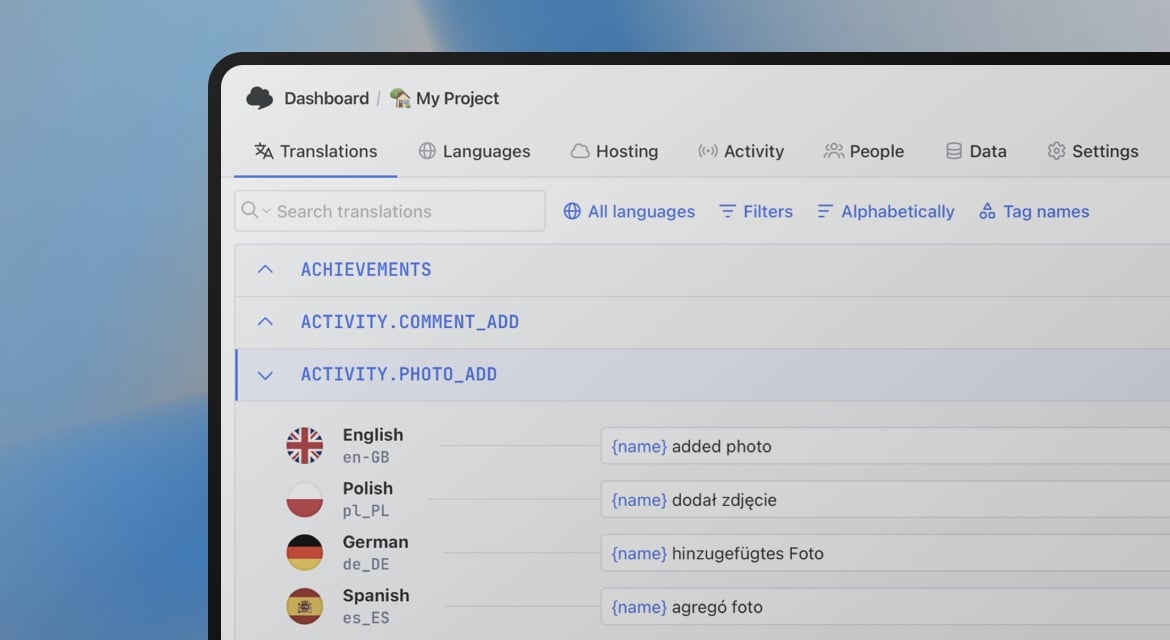
Pseudo-localization in SimpleLocalize
SimpleLocalize offers a pseudo-translation provider inside the translation editor, so you can fill a whole language with pseudo-localized strings and download it in any supported file format. See the auto-translation documentation for details.