 VS Code Extension available! Install now
Framer localization
with translation management system
Framer localizes your site, SimpleLocalize gets the translations done. Exchange content with XLIFF files and manage every language in one professional TMS.
 framer-de.xliff
<xliff version="1.2">
<file source-language="en"
target-language="de"
datatype="plaintext">
<body>
<trans-unit id="hero-headline">
<source>Build your site</source>
<target>Erstelle deine Website</target>
</trans-unit>
</body>
</file>
</xliff>Framer has built-in localization, but translating a growing site inside the editor quickly becomes a bottleneck. SimpleLocalize adds the layer Framer does not provide: auto-translation, translation memory, glossary, review workflows, and a dedicated editor your translators can use without touching the site.
Everything Framer exports, translated in one place
Framer groups your content into locales, localization groups, and localization sources. Export them as XLIFF files and every string lands in SimpleLocalize as a translation key.
Page content
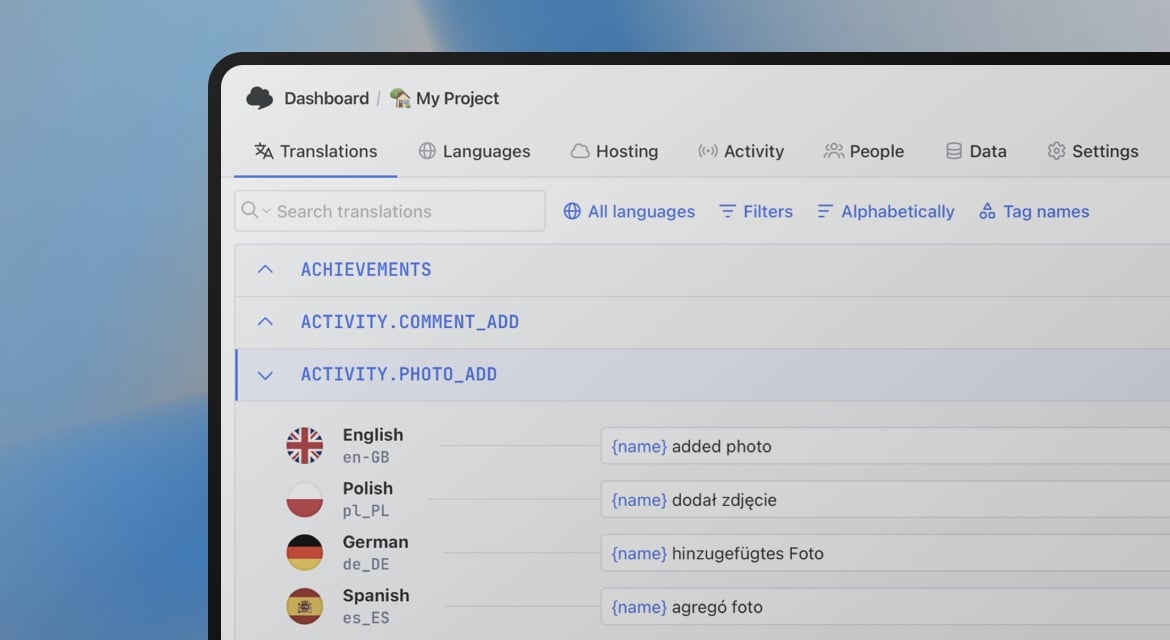
Headings, paragraphs, buttons, and labels from your Framer pages. Translate them in a proper editor instead of clicking through the canvas.
CMS items
Blog posts, case studies, product entries, and any other CMS-driven content Framer exposes in the Localization view.
Every locale
Each Framer locale becomes a separate XLIFF file and a separate language in SimpleLocalize, including regional variants like en-CA.
Two-way XLIFF exchange
Import what Framer exports, send finished translations back in the same format. Identifiers stay intact, so nothing is duplicated.
Context and comments
Add descriptions, comments, and screenshots to translation keys so translators know what a string means before they translate it.
One place for every product
Keep your Framer marketing site, your app, and your mobile strings in the same account, with shared glossary and translation memory.
How it works
From Framer to a fully
localized site in 4 steps
Framer exchanges localization data through XLIFF, the standard localization industry format. SimpleLocalize reads and writes exactly the same files, so no custom code is involved.
Export
Export XLIFF files from the Localization view in your Framer project.
Import
Upload the files to SimpleLocalize from the web app or with the CLI.
Translate
Auto-translate, reuse translation memory, and review with your team.
Publish
Import the translated files back into Framer and publish your site.
Why Framer teams add
a dedicated TMS
Framer is where your site lives. A translation management system is where translation work happens: machine translation, consistent terminology, reviews, and progress you can actually track.
Translating inside Framer only
- Manual editing locale by locale in the editor
- No translation memory or reuse across projects
- Translators need access to your Framer project
- No glossary to keep terminology consistent
- Hard to see what is missing across languages
- No review or approval workflow
- Time-consuming for content-heavy sites
SimpleLocalize
- Centralized editor for every language at once
- Team collaboration with roles and permissions
- Auto-translation with DeepL, Google, OpenAI, Anthropic
- Translation memory and glossary for consistency
- Quality checks before translations go live
- Progress tracking per language and per key
- Standard XLIFF in and out, no lock-in

Built for fast Framer localization
Turn an exported XLIFF file into a finished set of translations in minutes, then send it back to Framer.
AI auto-translation
Translate an entire Framer site draft in minutes with DeepL, Google Translate, OpenAI, or Anthropic, then refine only what matters.
Translators without access
Invite translators and reviewers to SimpleLocalize, assign languages, and keep your Framer project untouched.
Standard XLIFF
XLIFF 1.2 and XLIFF 2.0 are supported on import and export, so your content stays portable between tools.
Framer localization for growing sites
Whether you run a single landing page or a CMS-driven marketing site in six languages, the workflow stays the same.
Marketing websites
Translate landing pages, pricing sections, and navigation labels. Keep every language version aligned with your publishing schedule.
CMS-heavy Framer sites
Blog posts, case studies, and directories add up fast. Bulk translate CMS items and track what is still missing per language.
Agencies and studios
Handle several Framer clients from one dashboard. Assign translators per project and deliver consistent quality across all of them.
Framer site plus a product
Keep the marketing site and the application in one account, sharing a glossary and translation memory so your product speaks with one voice.
More than a Framer translation plugin
Export plugins move files around. SimpleLocalize is where the translation work happens: structured keys, comments and screenshots for context, QA checks, review statuses, history, and a translation memory that keeps paying off with every new page you ship.

- Auto-translation
- Screenshots with OCR
- AI-powered adjustments
- Built-in Automations
- Markdown support
- Variables highlighting
- Bulk Actions
- Context-aware translations
- Acceptance statuses
- Quality checks
- Comments & mentions
- Real-time collaboration
Why SimpleLocalize?
Most tools are overkill.
SimpleLocalize is fast, simple, and works out of the box.
Fast and customizable
SimpleLocalize is easy to get started with and focuses on the features that you and your team need the most. You can customize the editor to your needs choosing from a variety of options.
Flat pricing
No hidden costs! SimpleLocalize offers a simple and affordable plans for you and your projects. Within easy integration options and intuitive translation editor, it creates a wonderful selection.
Team members included
Every paid plan comes with a number of users you can add to your project. You don't need to worry about number of users as the price does not increase with every user.
Auto-translation included
Every paid plan comes with auto-translation characters that you receive every month. You can also use bring your own API keys and use them with SimpleLocalize in any plan (even free!).
Tools for Developers
SimpleLocalize gives developers the tools they need to automate and integrate localization into any workflow, such as CLI tool, VS Code extension, IntelliJ plugin, Figma integration, and more.
Personal support
From “how do I get started” to “I need XYZ” requests, when you need that extra helping hand, we’re here for you. We are here to make sure you get the most out of SimpleLocalize.
Trusted by developers and translators at














Start translating your Framer site today
- Import XLIFF files exported from Framer
- Auto-translate every locale in minutes
- Collaborate with translators and reviewers
- Export translations back in the same format
- No coding required
"The product
and support
are fantastic."
"The support is
blazing fast,
thank you Jakub!"
"Interface that
makes any dev
feel at home!"
"Excellent app,
saves my time
and money"
How do I translate a Framer website?
Enable localization in Framer and add the locales you need. Export the localization data as XLIFF files from the Localization view, import them into SimpleLocalize, translate them there, and import the finished files back into Framer before publishing.
Which file format does Framer use for translations?
Framer exchanges localization data with external tools using XLIFF, the standard localization industry format. SimpleLocalize supports both XLIFF 1.2 and XLIFF 2.0 on import and export, so the files go in and out unchanged.
Is there a SimpleLocalize plugin for Framer?
Not yet. Today the integration works through XLIFF file exchange, which requires no plugin from us and no custom code on your side. Framer exposes localization data only to plugins running inside the editor, so the export and import steps happen there.
Can I auto-translate a Framer site?
Yes. Once your content is in SimpleLocalize you can auto-translate it with DeepL, Google Translate, OpenAI, or Anthropic using your own API key, then review the results before sending them back to Framer.
Do translations sync automatically with Framer?
No. The exchange is file-based, so a person with access to the Framer project runs the export and the import. Everything on the SimpleLocalize side, including uploads, auto-translation, and downloads, can be scripted with the command-line tool.
Can several translators work on the same Framer site?
Yes. Invite translators and reviewers to your SimpleLocalize project, assign roles and languages, leave comments, and track progress, all without giving anyone access to Framer.