White-label
localization
Stop duplicating projects for every client.
Manage tenant-specific translations from one place.
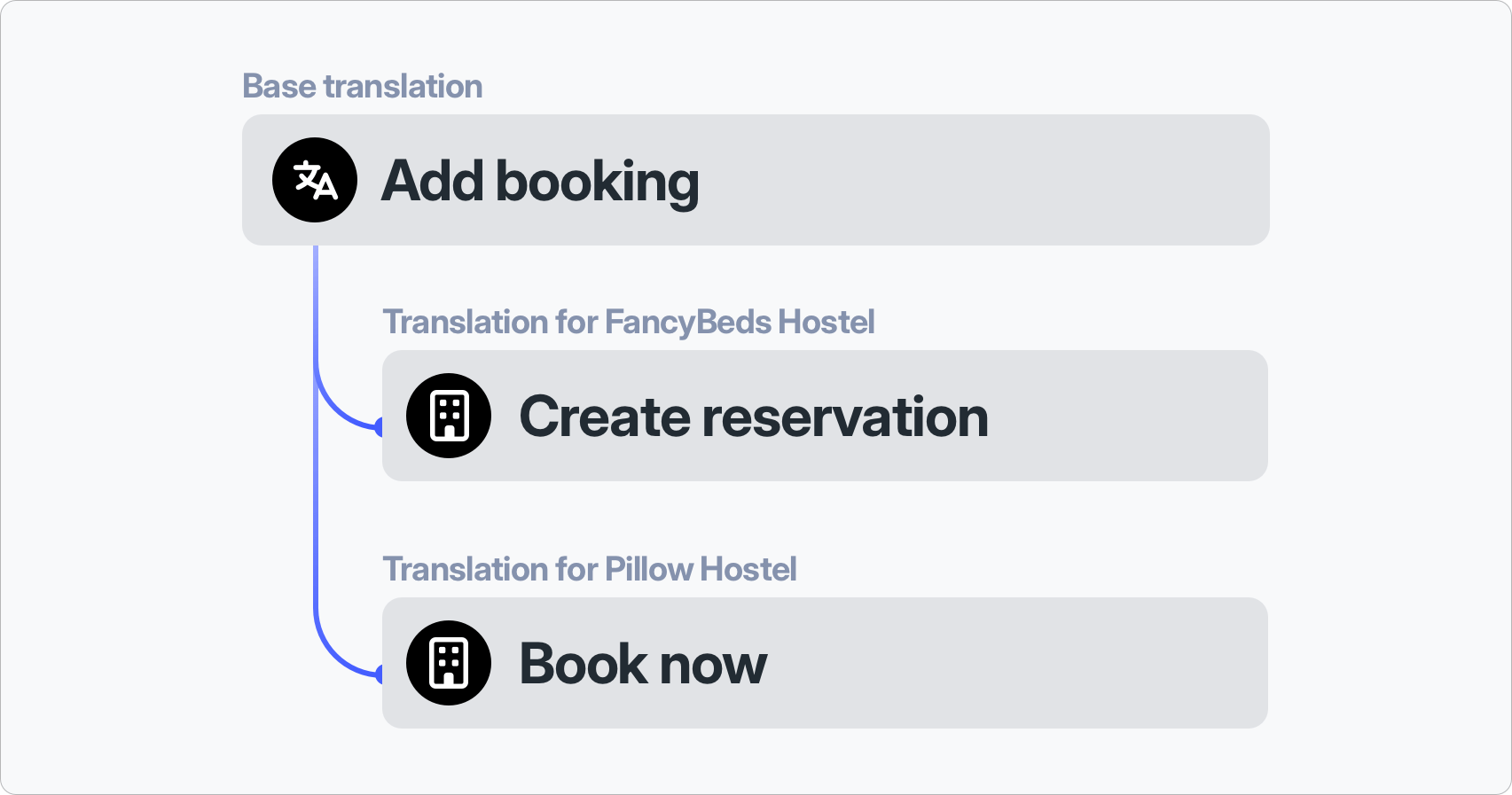
What is white-label localization?
Override default translations for individual customers, tenants, or resellers without forking your codebase or duplicating files. Each client gets branded text while you maintain a single source of truth.
SimpleLocalize handles this natively with customer contexts, a layer on top of your base translations for per-tenant overrides, per language, without affecting anyone else. It's part of the complete translation management system.
What you're doing today and what changes
If you manage translations for multiple clients, you already know these workarounds.
One project, not 40
Separate translation project per customer with duplicate content.One project with multiple customer contexts. Each tenant overrides only what differs.
Update once
Copy-pasting base translations to every client file.Change the base once and every tenant that hasn't overridden it inherits the update automatically.
Real client isolation
Shared accounts or no access control between clients.Per-context permissions so tenants only see and edit their own translations.
Minutes, not days
Clone project, re-import files, reconfigure.Create a customer context, add a few overrides, publish. New tenant live in minutes.
Real-world example
40 hotel brands, one translation project
A booking engine SaaS serves 40 hotel brands. Each brand has slightly different button labels, notification text, and onboarding copy. Before customer contexts, the team maintained 40 separate translation projects, syncing base changes across all of them, fixing inconsistencies weekly, and onboarding each new hotel manually.
With SimpleLocalize, they manage one project. Each hotel brand is a customer context with overrides for the 10-30 keys that differ. Base translations update once and propagate everywhere. New brands go live in minutes. The team went from spending hours on translation sync to not thinking about it at all.
How white-label translation management works
From creating a customer context to delivering tenant‑specific translations. Here is the full workflow.
Read the docs →Create customer contexts
hotel_chain_a) links overrides to the right audience.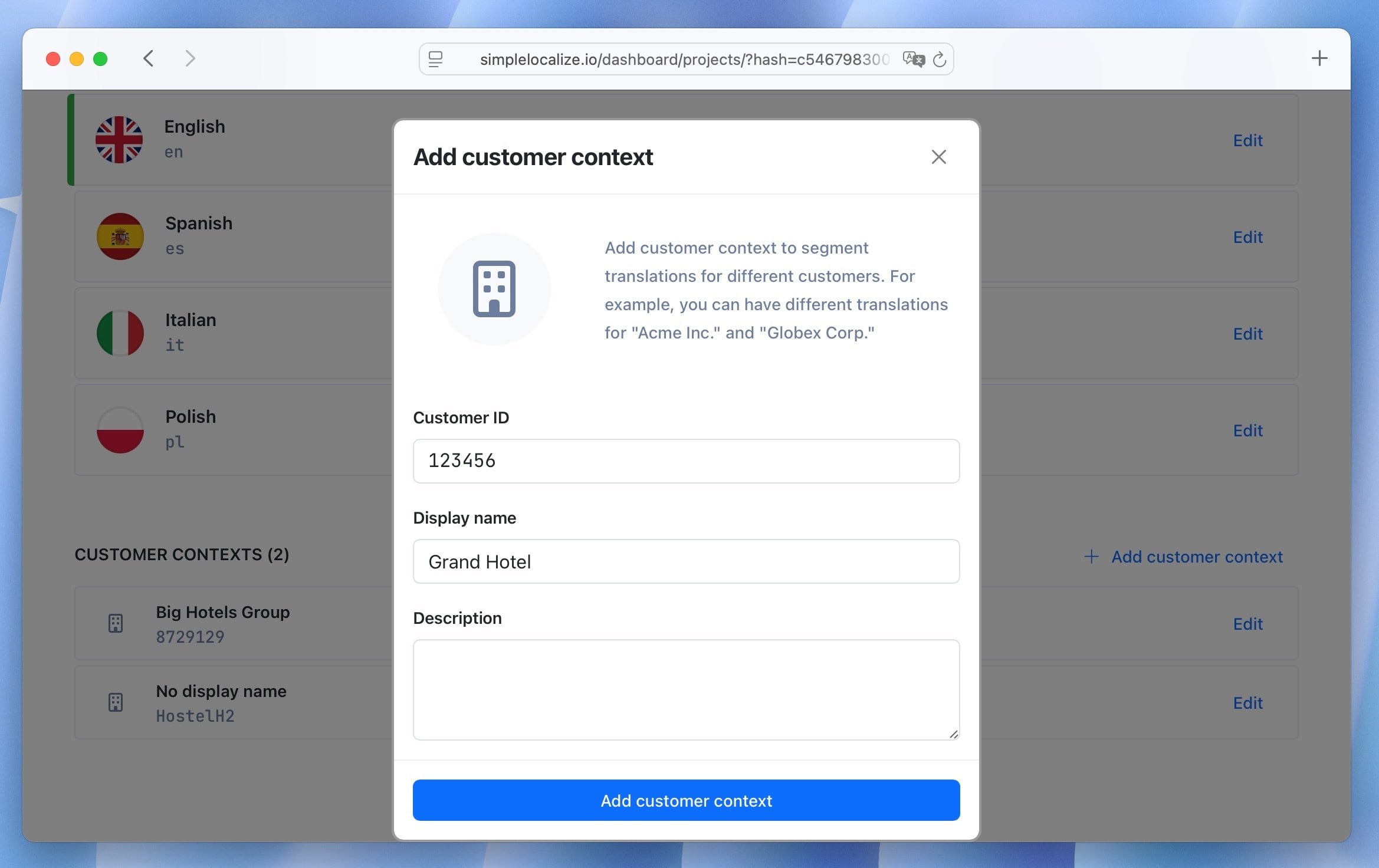
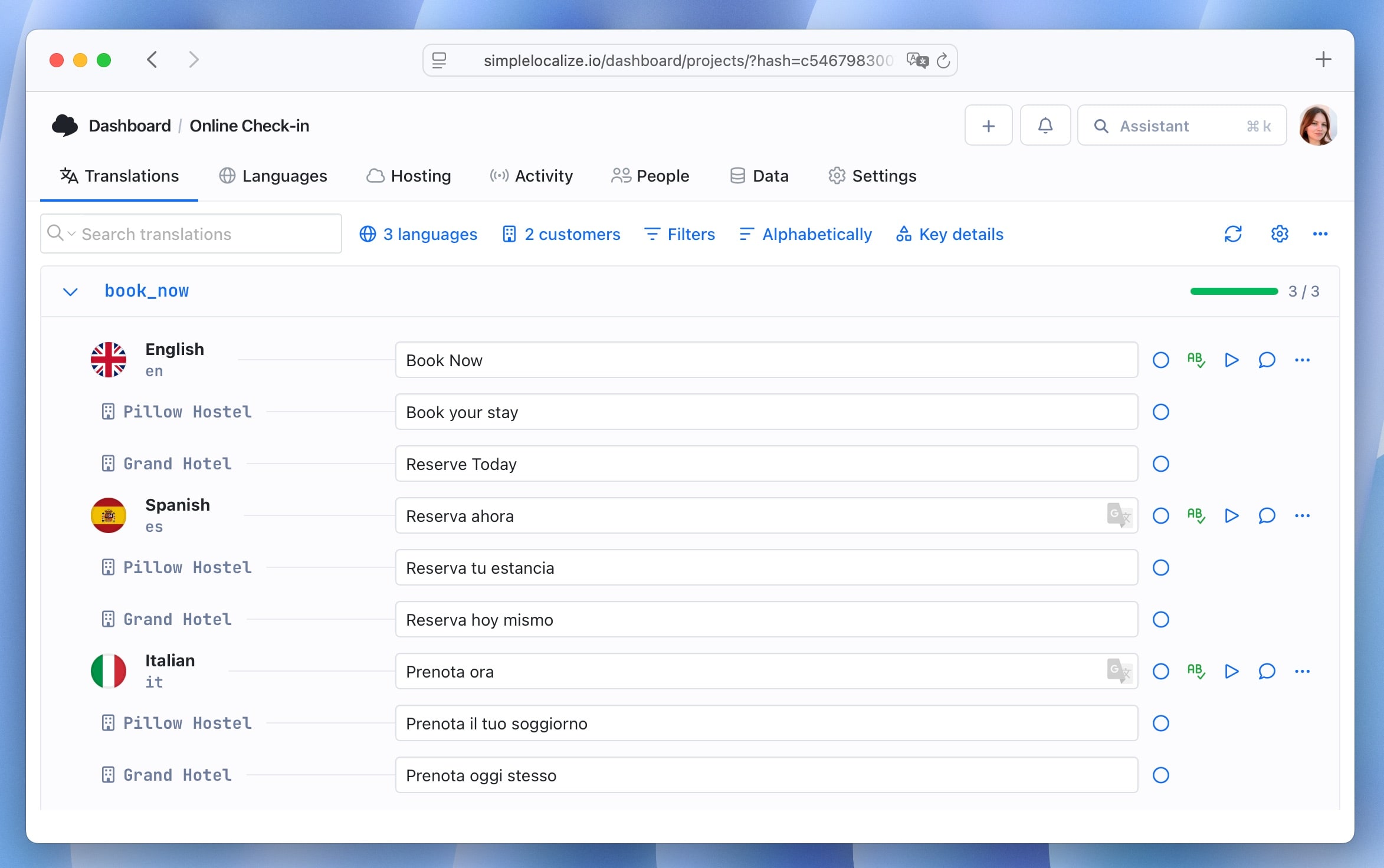
Add translation overrides
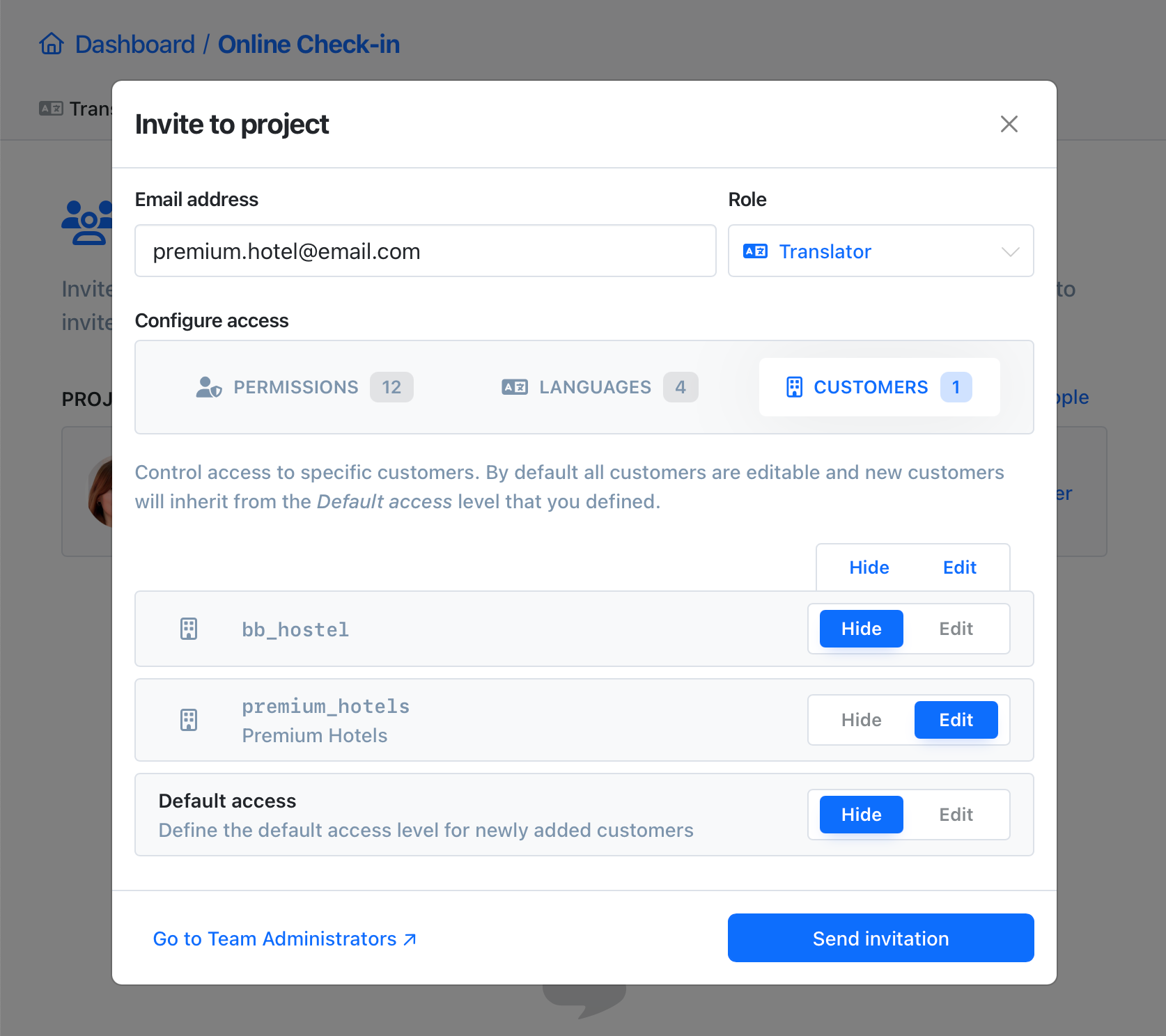
Control access per tenant
Deliver via CDN, CLI, or API
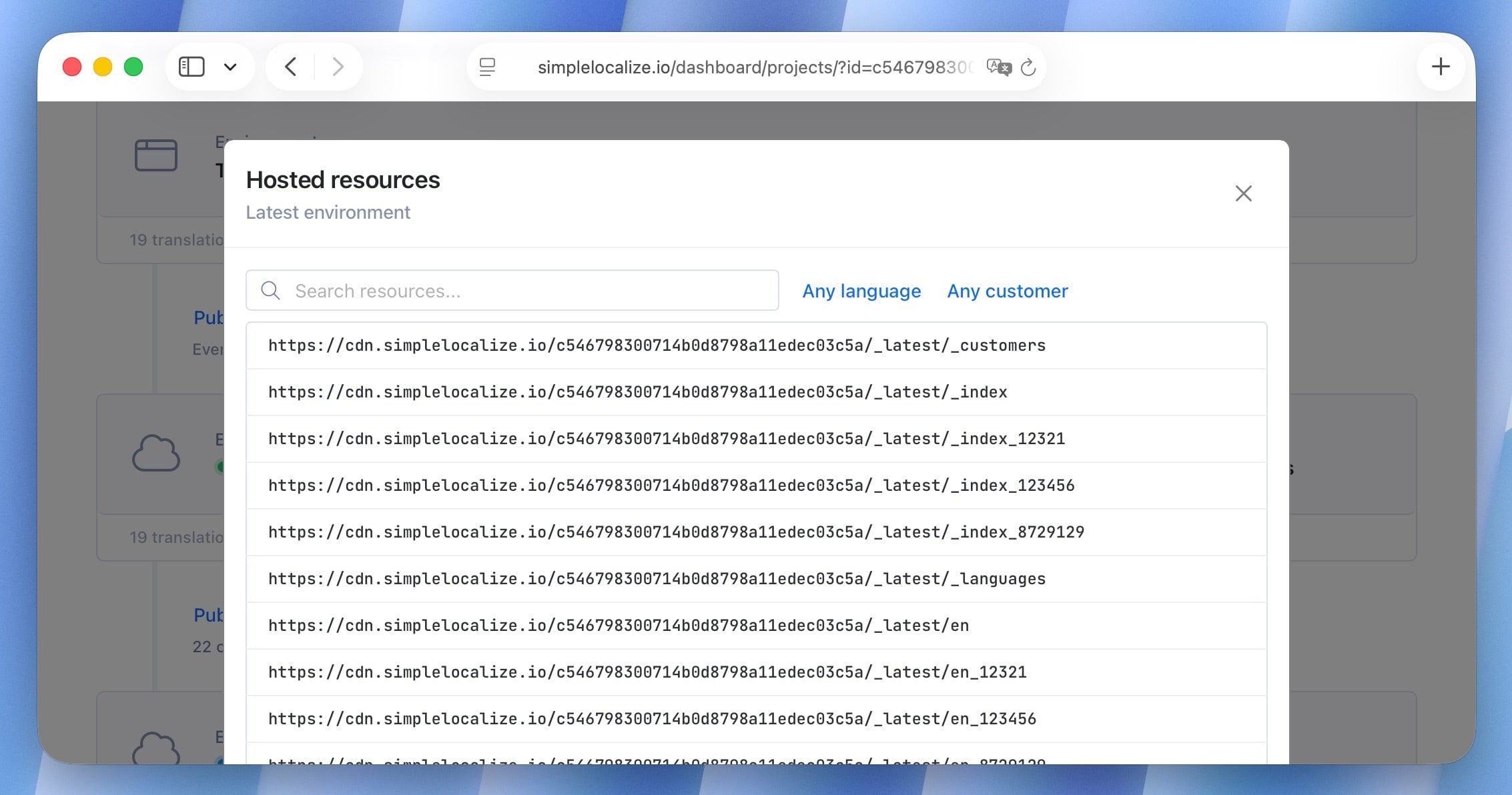
Built natively for per-tenant translation overrides
Most translation management systems force you to create separate projects per customer. SimpleLocalize has customer contexts as a first-class feature. No duplication, no workarounds.
Start for freeBuilt for multi-tenant localization
Everything you need to manage per-tenant translations alongside your base localization workflow.
White-label translation management
With vs without native tenant support
Most TMS platforms force you to use workarounds for multi-tenant translations. SimpleLocalize handles it natively.
Who uses white-label localization?
Part of the SimpleLocalize
localization platform
Customer contexts integrate with every other feature in the SimpleLocalize platform.
Continuous Localization
Sync tenant-specific translations alongside your base translations. Auto-translate, review, and publish within your CI/CD pipeline.
Localization API
Full REST API for managing customer contexts, translation overrides, and per-tenant delivery programmatically.
Translation Hosting (CDN)
Deliver per-tenant translations via a global CDN. Each customer context gets its own endpoint. Fetch by language and tenant ID.
We power your product localization
From first commit to global launch














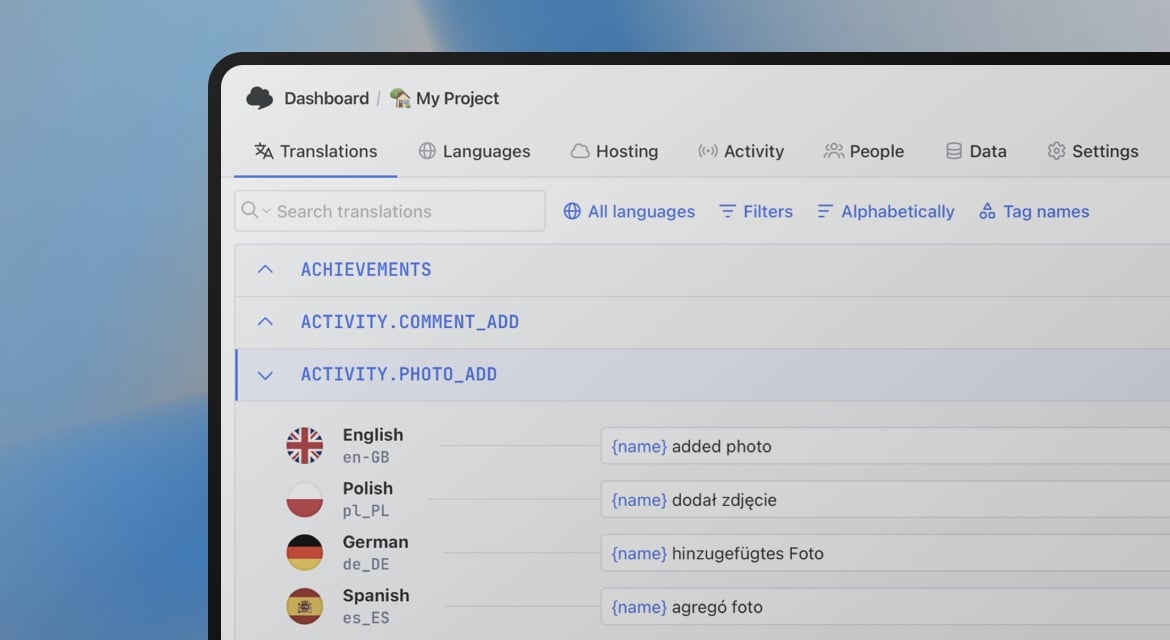
Start managing per-tenant translations
- All-in-one localization platform
- Web-based translation editor for your team
- Auto-translation, QA-checks, AI and more
- See how easily you can start localizing your product.
- Powerful API, hosting, integrations and developer tools
- Unmatched customer support
"The product
and support
are fantastic."
"The support is
blazing fast,
thank you Jakub!"
"Interface that
makes any dev
feel at home!"
"Excellent app,
saves my time
and money"
Learn more about white-label localization
Guides, best practices, and tutorials for managing customer-specific and multi-tenant translations.
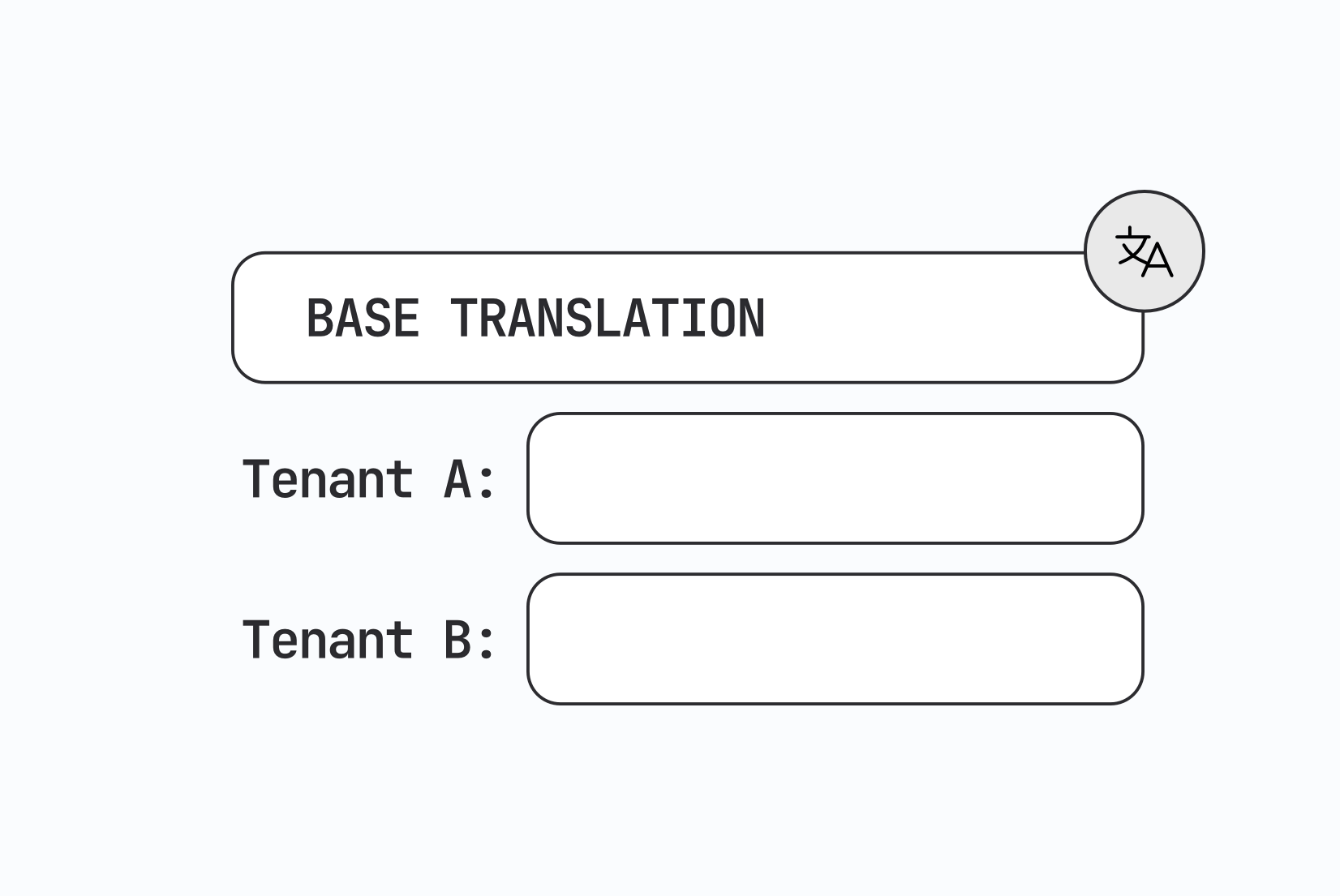
Designing multi-tenant localization systems
How to design multi-tenant localization: data models for tenant-specific translations, fallback order, CDN delivery, caching, permissions, and a working setup with customer contexts in SimpleLocalize.
Localization budget planning: A practical guide for SaaS teams
How to build a realistic localization budget: translation costs, tooling, engineering time, QA, and maintenance, with a per-language cost model.
Signals it's time to localize your SaaS product
Not sure if you're ready to localize? Here are the concrete signals, from traffic to support tickets to deal stage, that tell you it's time.
Tone of voice and formality across cultures
A translated string can be accurate and still sound wrong. Learn how tone and formality shift across languages and cultures, with real examples.
i18n vs localization: Who owns what on your team?
Learn how to define ownership across engineering, product, and localization teams for scalable translation workflows.

AI and machine translation for software localization: The complete guide
Everything teams need to know about AI and machine translation for software localization. How LLMs compare to MT engines, how context works, when to use each, and how to build a production-grade automated translation pipeline.
What is white-label localization?
White-label localization (also called client-specific localization or per-tenant translation management) is the process of managing translations for a product that is resold or rebranded by multiple clients. Each client (or tenant) needs the ability to customize text, labels, and messages to match their brand, industry, or audience, without affecting the base product or other tenants.
In practice, this means maintaining a single set of translation keys with optional per-tenant overrides. A booking engine might use “Book Now” as the default, while tenant A overrides it to “Reserve Your Stay” and tenant B uses “Book Today.” SimpleLocalize is the only localization platform that supports this natively through customer contexts, a dedicated layer for translation overrides that sits on top of your base translations. Read the full guide on customer-specific translations to learn more.
How per-tenant translations work in SimpleLocalize
SimpleLocalize introduces the concept of customer contexts. A customer context is a named scope (e.g., hotel_chain_a) that holds translation overrides for a specific tenant. When you fetch translations for that tenant, SimpleLocalize merges the base translations with the overrides. The override wins where it exists, and the base is used everywhere else.
This approach eliminates the need to duplicate projects, fork translation files, or maintain separate export pipelines per client. You manage everything in one project, and the platform handles the layering. Customer contexts work across all delivery methods: Translation Hosting CDN, REST API, and CLI exports. There is no limit on the number of contexts you can create: one per client, one per reseller, or any grouping that makes sense.
White-label localization vs separate projects per customer
The most common workaround in other TMS platforms is to create a separate project for each customer. This leads to duplicated keys, inconsistent base translations, and exponential maintenance overhead as the number of tenants grows. Updating a shared string means propagating the change across every project manually.
With SimpleLocalize's customer contexts, you maintain one project with one set of keys. Tenants only override what differs. Base translation updates propagate automatically to every tenant that hasn't overridden that key. This is the difference between a workaround and native multi-tenant localization support, and it scales from 2 tenants to 2,000 without changing your workflow. Our guide to designing multi-tenant localization systems compares these data models and explains fallback order, caching, and permissions per tenant.
Giving tenants access to their own translations
Invite clients directly to your SimpleLocalize project and scope their access to a specific customer context. You control what each tenant can do: view, edit, or suggest translations. Tenants never see other customers' overrides or your internal project structure, ensuring full data isolation between clients.
For broader collaboration, enable public suggestions to let tenant end-users propose translation changes through a shared link. This is useful for community-driven localization or when tenants want their own users to contribute translations without requiring a project account.
Delivering tenant-specific translations at scale
SimpleLocalize provides three ways to deliver per-tenant translations. The Translation Hosting CDN publishes each customer context as a separate resource. Your app fetches translations by language key and customer ID (e.g., en_hotel_chain_a). The CLI supports a --customerId flag for downloading tenant-specific files in your CI/CD pipeline. And the REST API provides full programmatic access to query and export overrides per customer context.
All three methods return merged translations (base plus overrides), so your application logic stays simple. If a key has no override for the given tenant, the default translation is returned automatically. Your frontend or backend just fetches one URL and gets the right content for the right tenant.
Use cases for per-tenant translations
White-label and multi-tenant localization applies to a wide range of products. White-label SaaS platforms where resellers rebrand UI text to match their own identity. Multi-tenant applications where each client has industry-specific terminology. A logistics platform might say “Shipment” for one client and “Delivery” for another. Booking engines, CRMs, and ERPs that serve hotels, clinics, or retailers, each with different expectations for button labels, notifications, and emails.
Enterprise software with department-level customization also benefits: HR, finance, and engineering teams within the same company may need different wording for shared features. And marketplace platforms often need entirely different text for seller-facing vs buyer-facing interfaces, which customer contexts handle cleanly.
Benefits of native multi-tenant localization
The core benefit is operational efficiency: one project, one set of keys, with overrides only where needed. This eliminates the duplication and drift that come from maintaining separate projects per customer. Base translations update once and propagate to every tenant automatically.
For your clients, it means a personalized experience. The product speaks their language, literally and figuratively. Onboarding new tenants is fast because you only customize what differs. Support overhead drops because clients can manage their own translations. And your continuous localization workflow stays simple regardless of how many tenants you serve.
Frequently asked questions
What is the difference between customer translations and separate language variants?
Customer translations (also called per-tenant overrides) let you override specific keys for a specific client without creating a new language. A separate language variant would require duplicating all translations. Customer contexts in SimpleLocalize are more efficient: you only maintain the overrides, and the base translation is served for everything else.
Can tenants manage their own translations?
Yes. You can invite tenants to your SimpleLocalize project and restrict their access to their own customer context. They can view, edit, or suggest translations depending on the permissions you set, without seeing other tenants' data.
How many customer contexts can I create?
SimpleLocalize offers 25 customer context on the Business plan, and you can request more if needed. There is no technical limit on the number of contexts you can create. It scales with your needs.
Do customer contexts work with auto-translation?
Yes. You can auto-translate base translations and customer-specific overrides using DeepL, Google Translate, or OpenAI.
How do I fetch translations for a specific tenant?
You can fetch tenant-specific translations via the Translation Hosting CDN by appending the customer ID to the language key (e.g., en_hotel_chain_a). Alternatively, use the CLI with --customerId or the REST API with the customer context parameter. See the documentation for full details.
Is white-label localization the same as multi-tenant localization?
They are closely related. White-label localization typically refers to reseller or rebranded products where each client gets a fully branded experience. Multi-tenant localization is broader and covers any architecture where multiple tenants share a codebase and need per-tenant text customization. SimpleLocalize's customer contexts support both patterns.