Invite your team and translators to SimpleLocalize and work together on your multi-language projects.

Roles
In SimpleLocalize, we distinguish 5 user roles: owner, administrator, project administrator, developer, and translator. Each role has its own set of permissions and access levels.
Owner
Owner is the highest role in SimpleLocalize. The owner is the user who created the subscription and has full access to all projects and subscription settings.
The project owner has the highest authority in the project. The project owner can:
- manage subscription settings,
- manage the project settings,
- invite other project members to the organization and projects,
- delete projects,
- set users as administrators,
- transfer ownership to another user.
Administrator
Administrator role is having access to all the projects automatically within the subscription.
Administrators have all the permissions of project owner, except for the following:
- delete projects,
- manage the subscription,
- view invoices,
- increase auto-translation limit.
To set a user as an administrator, go to the Team section and select Add as Administrator from the dropdown menu.

Project administrator
Project administrator is a role that has access to only selected projects, they still can manage the project settings, but they cannot manage access levels for other projects and users.
Developer
Developer rights are equal to the Project administrator role, but with the following limitations:
Developers:
- don't have access to the project Settings tab,
- can only view the People tab; they can't invite, remove, or change the role/access of project members, and can't view or manage shareable invitation links.
Translator
Translator is the role designed to be focused only on translations.
By default, translators have access to the following tabs:
- Translations tab
- Languages tab
- Data tab
- Activity tab
Permissions
You can set permissions for translators to restrict their access to some parts of the project.
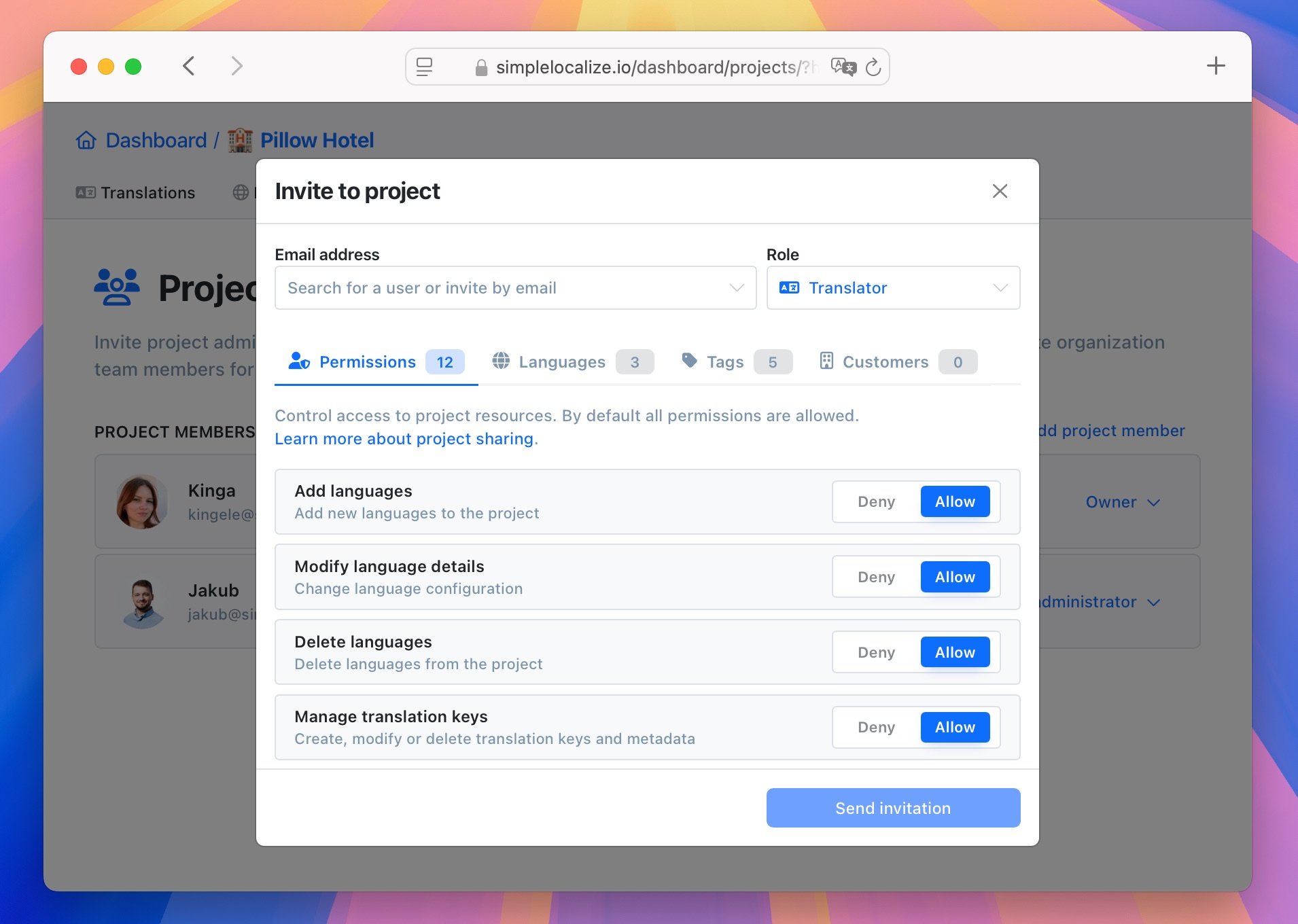
List of available permissions:
- Manage languages: allows adding, modifying, and deleting project languages in the 'Languages' tab.
- Manage translation keys: allows adding, modifying, and deleting translation keys in the 'Translations' tab.
- AI & Auto-translation: allows using auto-translation and AI features.
- Publish translations: allows publishing translations in the 'Translations' tab via the 'Save & Publish' button.
- Import files: allows importing data from the 'Data' tab, regardless of the assigned languages, tags, and other user permissions.
- Export files: allows exporting data from the 'Data' tab, regardless of the assigned languages, tags, and other user permissions.
- View activity: allows viewing activity in the 'Activity' tab.
- Comments & Suggestions: allows viewing and adding comments and suggestions.
- Change description: allows changing descriptions for translation keys in the 'Translations' tab.
- Change translations: allows changing translations for translation keys in the 'Translations' tab. It applies to all languages to which the translator has 'Edit' access.
- Review translations: allows reviewing translations for translation keys in 'Translations' tab. It applies to all languages to which the translator has 'Edit' access.
- Change customer translations: allows changing customer context translations for translation keys in 'Translations' tab. It applies to all languages to which the translator has 'Edit' access.
- Review customer translations: allows reviewing customer context translations. It applies to all languages to which the translator has 'Edit' access.
Language access
By default, every translator has access to all project languages. They can view and modify translations for every language. With the language access permissions you can restrict translator language access to view only, or hide some languages completely from the UI.
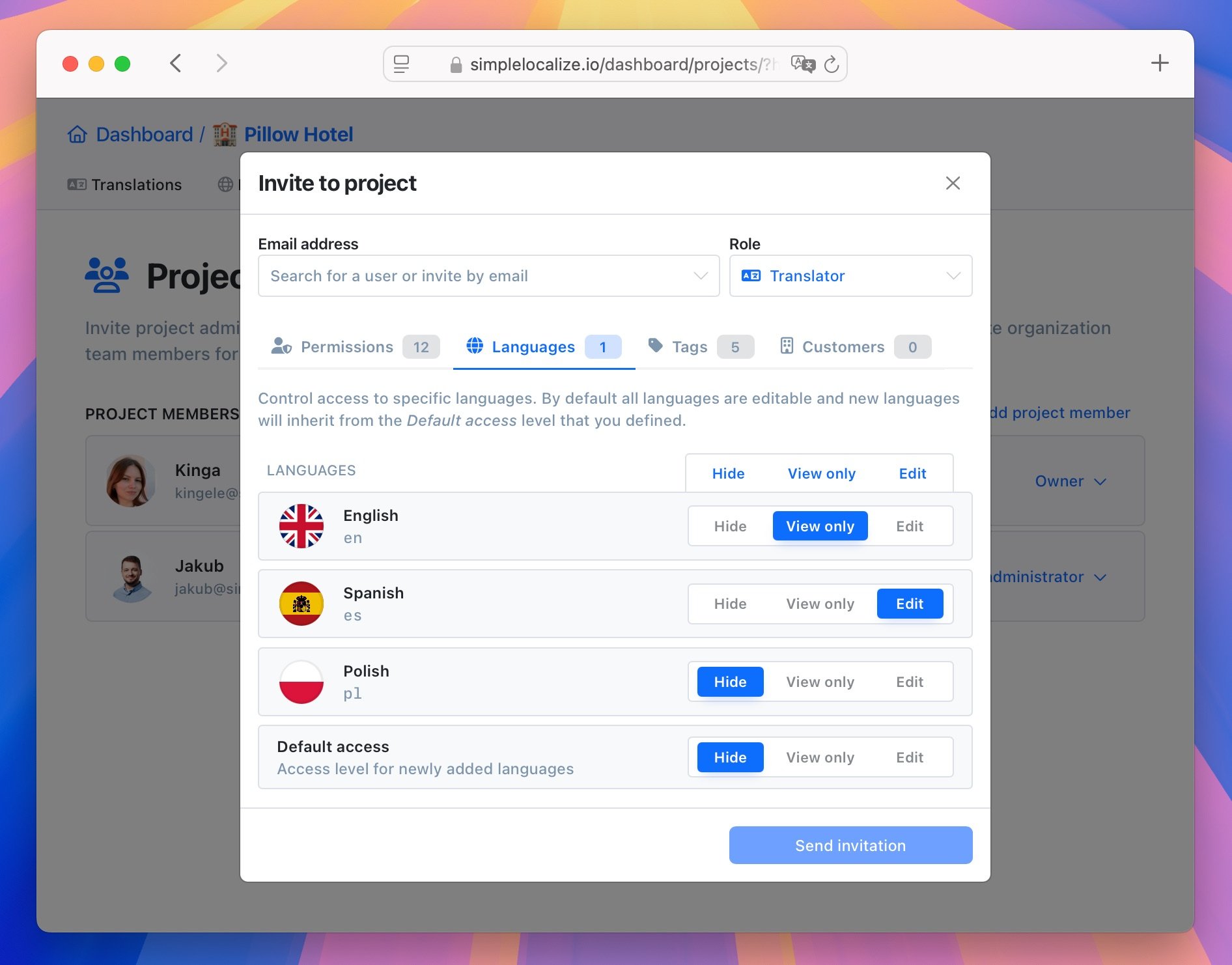
At the bottom of the language list, you can adjust the default access for newly added languages. You can set the default access to view only, edit or hide.
Tags access
By default, every translator has access to all project tags. They can view translations for every tag. With the tags access permissions you can restrict translators access to view translations with specific tags only, or hide translations with tags completely from the UI.
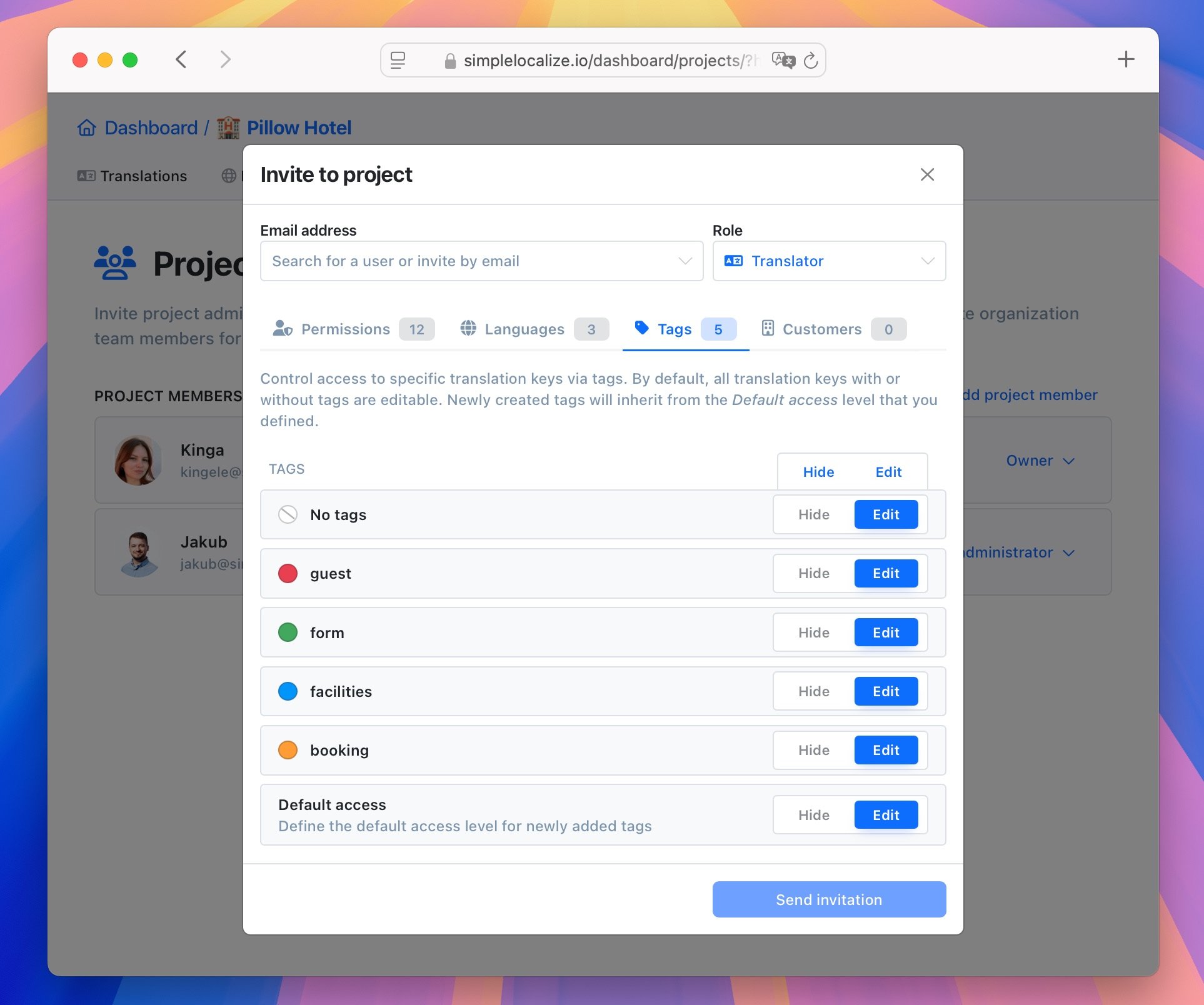
You can set the default access for newly added tags at the bottom of the tags list.
Customer context access
By default, every translator has access to all customer context translations. They can view and modify customer context translations in languages they have access to. With the customer context access permissions, you can restrict translator access to view only, or hide customer context translations completely from the UI.
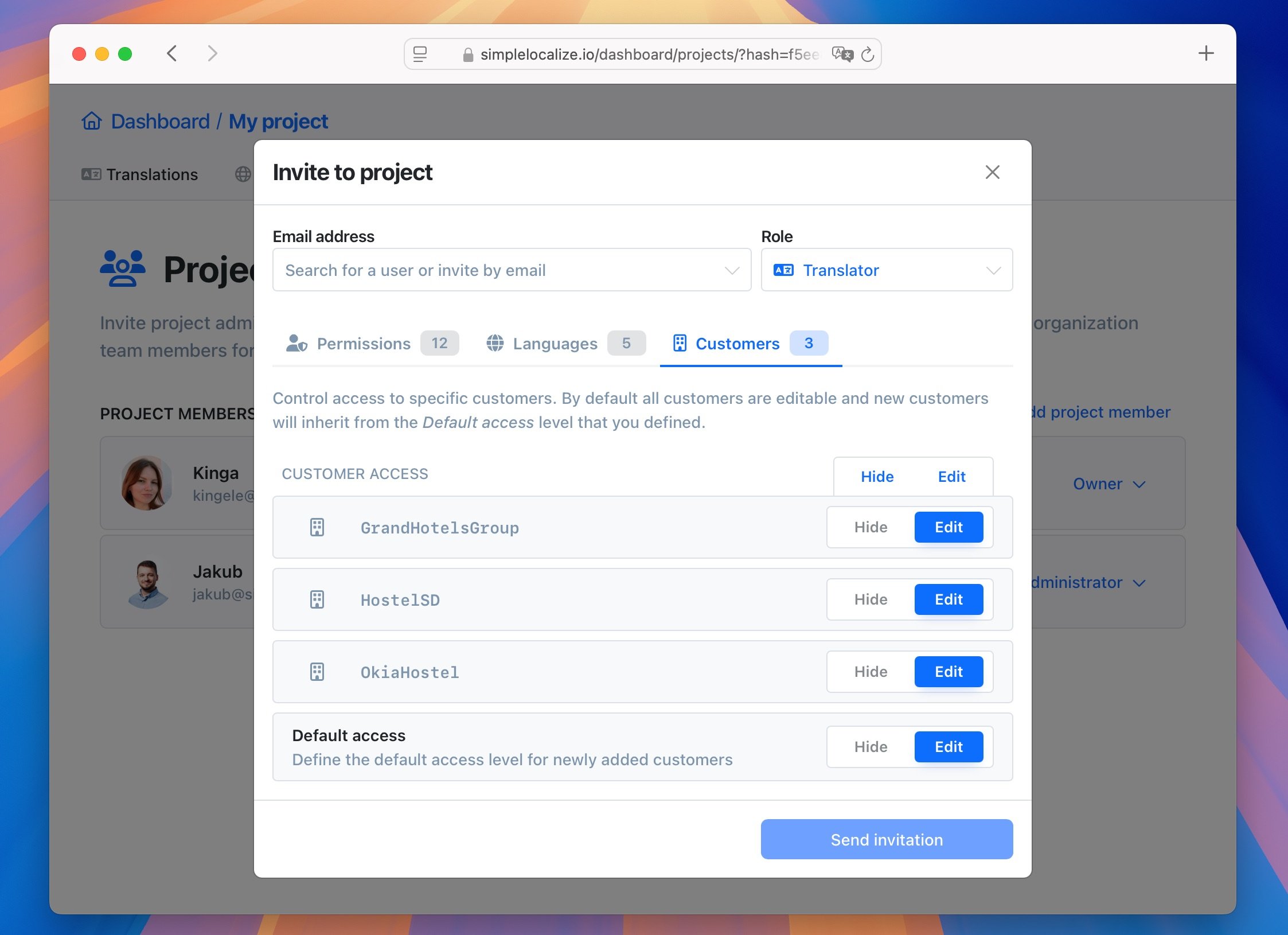
At the bottom of the customer's list, you can adjust the default access for newly added customers.
With this feature, you can share your project with your customers and allow them to provide translations for their own context, without giving them access or preview to other customers translations.
Share project access
Shareable project links are an easy way of inviting more people at once to a project without knowing their e-mail address. You can find the Share project option in the 'People' tab.
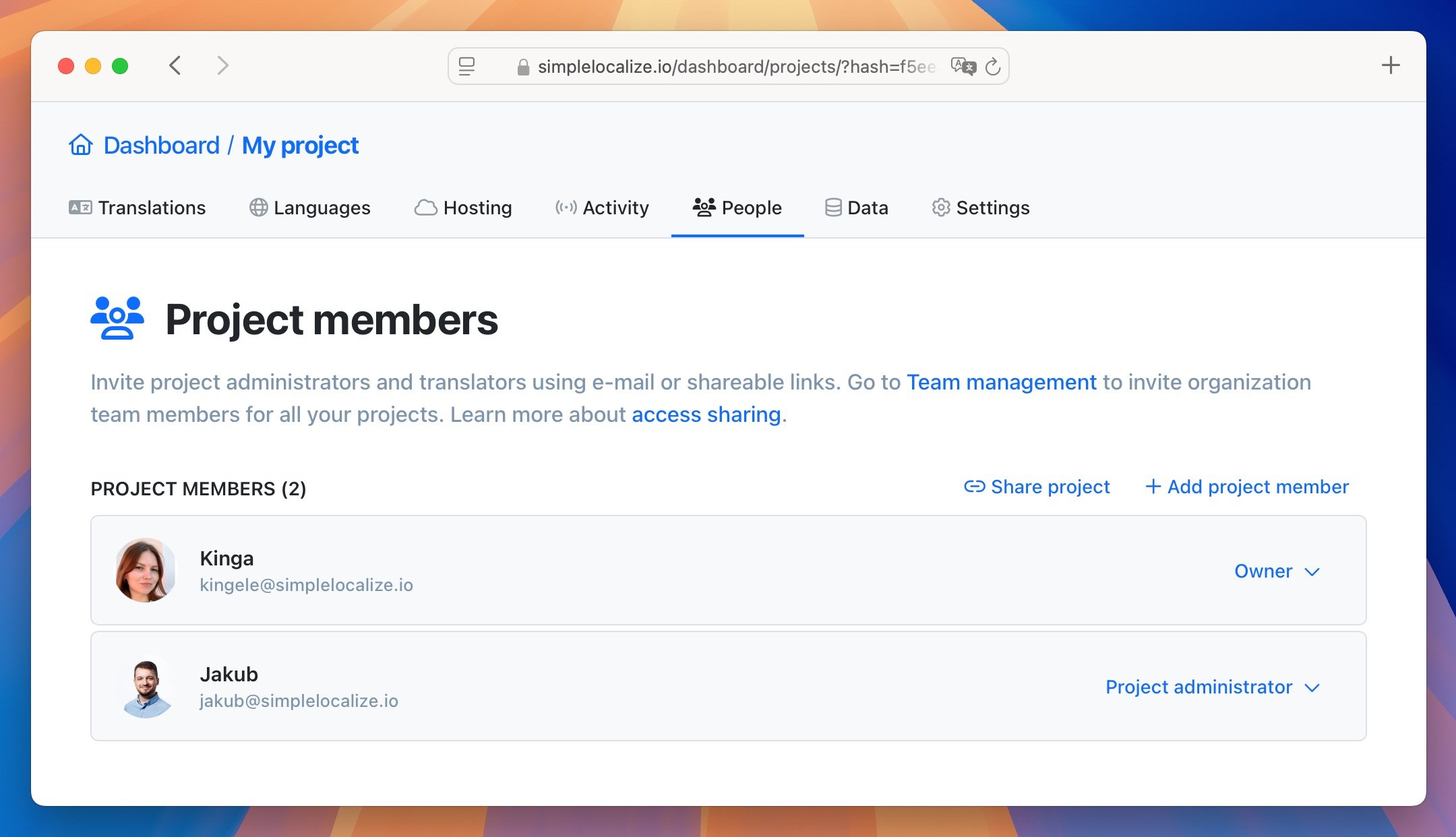
Click on Create shareable link button to generate a new shareable link. There are two types of shareable links. One is for inviting project administrators and the second one is for inviting translators.
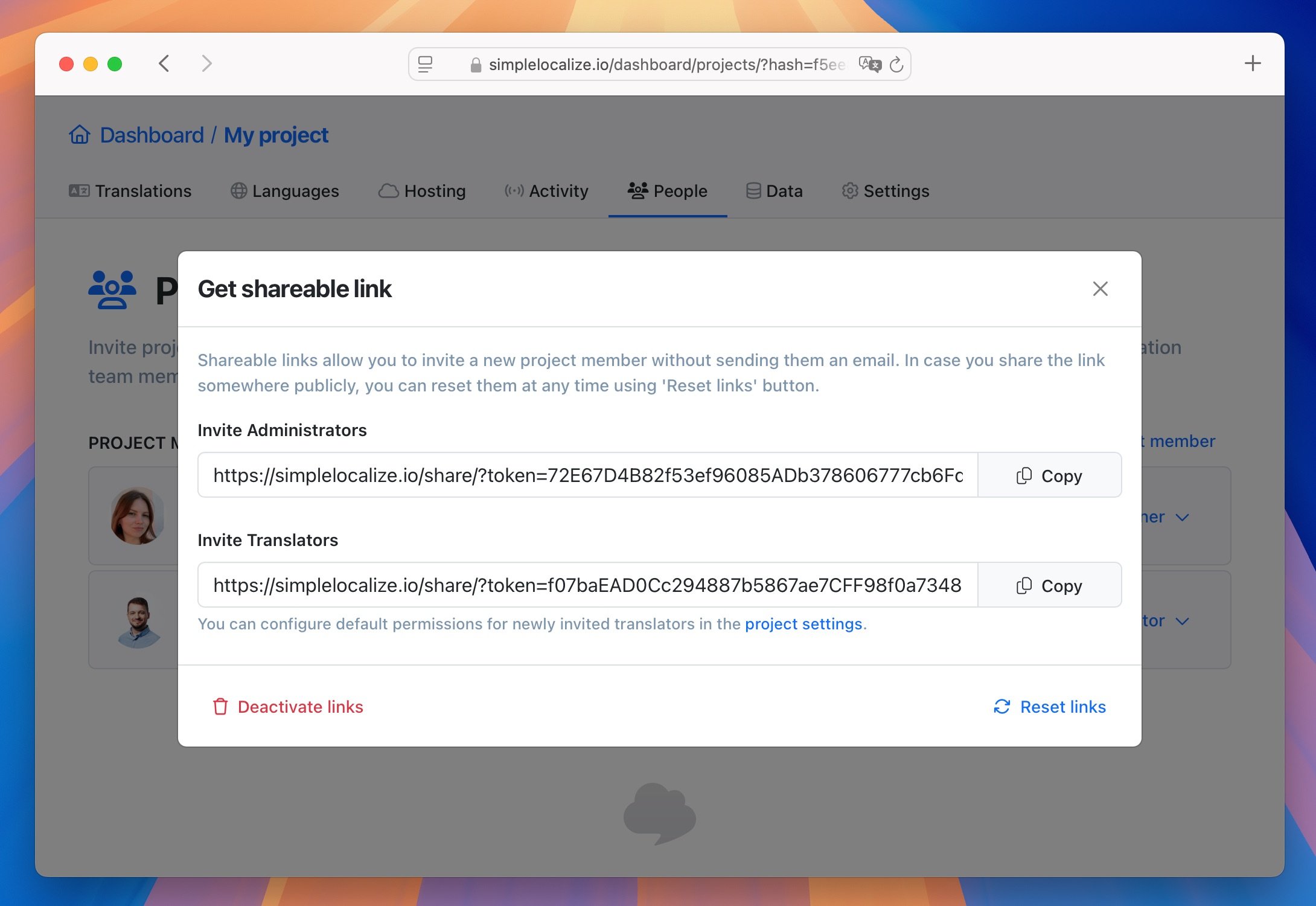
A person who would like to use the invitation link must create an account first in SimpleLocalize.
You can reset shared links by clicking the 'Reset link' button or deactivate them by clicking the 'Deactivate links' button. If you decide to enable them again, the system will generate new links.
Add project member
To invite a project member, go to the 'People' tab in your project and click 'Add member' button on the right side.
There, enter the e-mail address of the person you want to invite to the project and select the role you want to assign to the person.
Available roles are Administrator, Project Administrator, Developer and Translator.
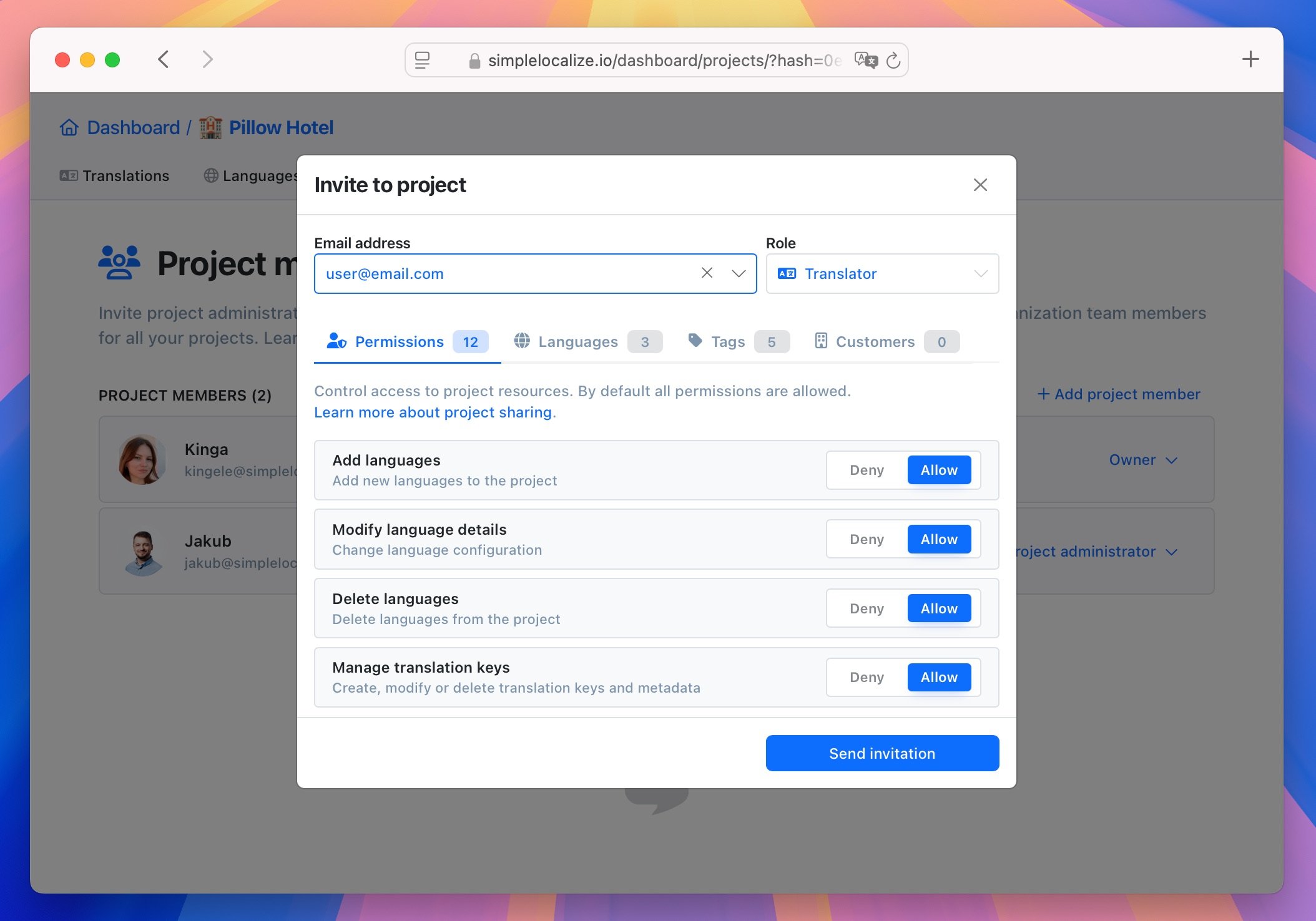
SimpleLocalize will send an e-mail with an invitation automatically after you click the Send invitation button. The invitation e-mail will contain an invitation link which will redirect the recipient to the new account page, or the invitation page where he/she can accept the invitation. After that, the invited person can sign in to the account.
Add team member
SimpleLocalize allows you to manage your team members in one place. As a subscription owner or administrator, you can invite your team members to the subscription and manage their roles and access levels.
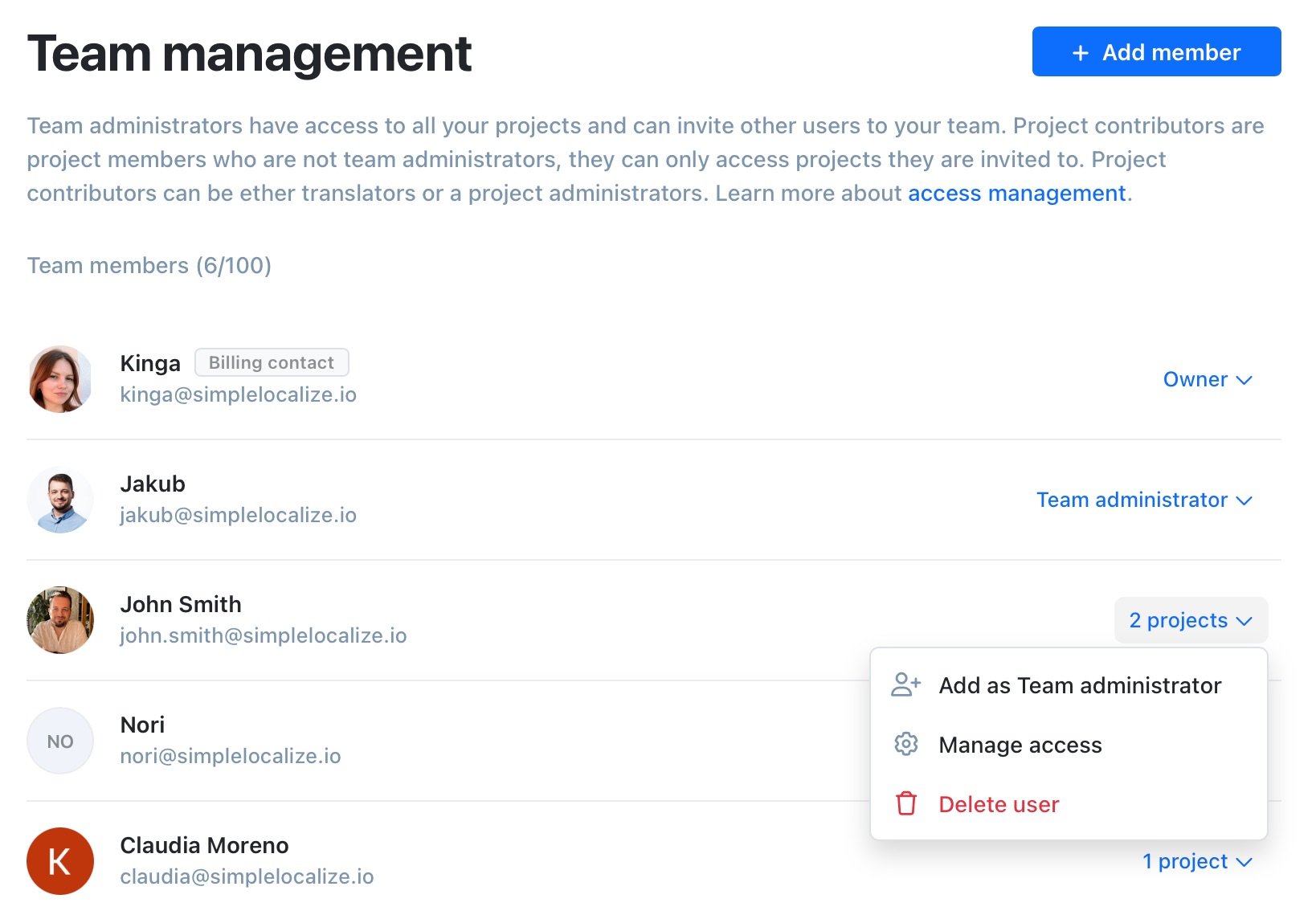
To manage your team members, please go to the Team section.
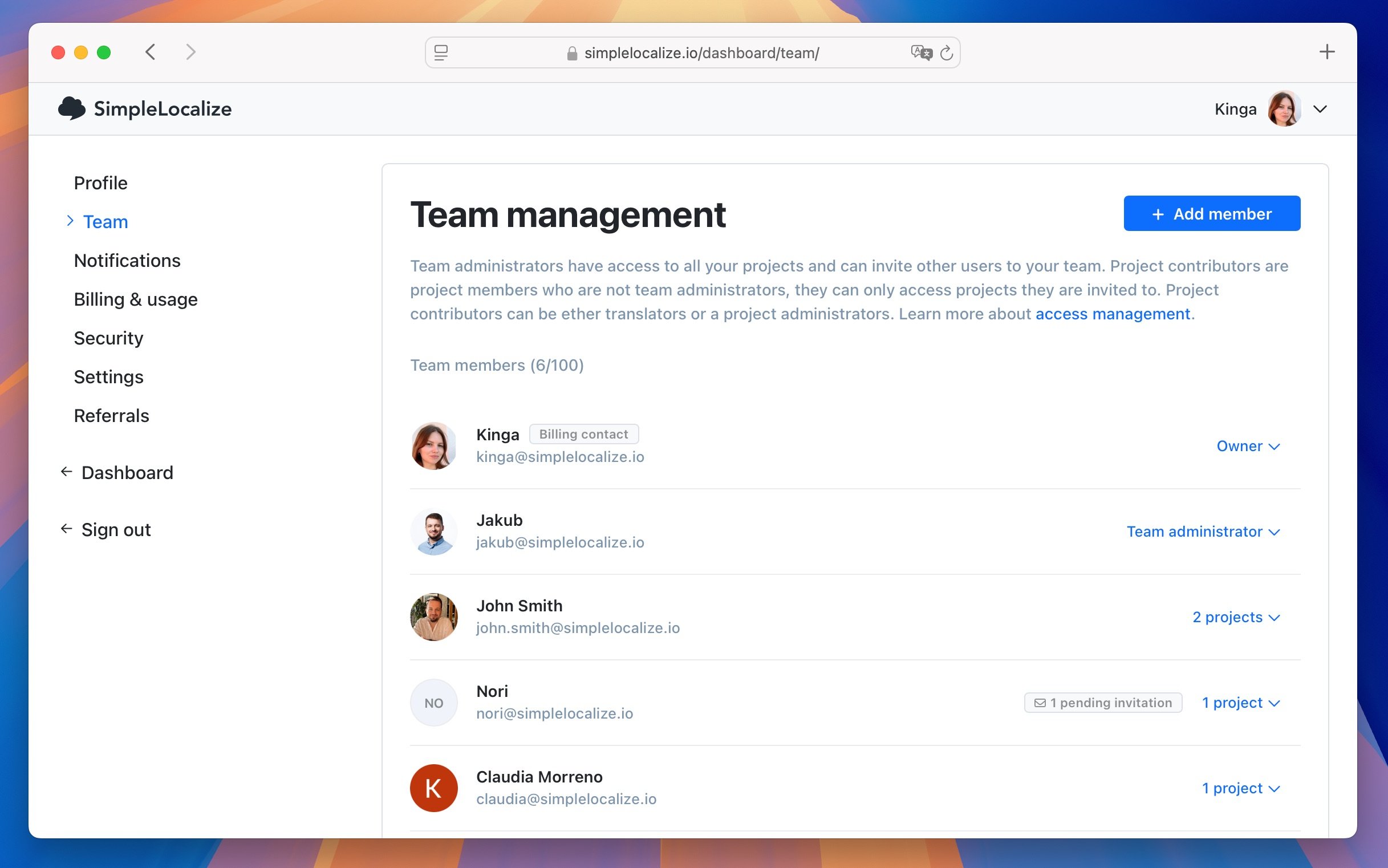
There, you can see the list of all team members and their roles. You can invite new team members by clicking the 'Add member' button. You can also change the roles, permissions, and projects for each team member.
Manage access
In the Team section, you can manage the project access for each team member. You can set the role for each team member in each project. You can also remove the team member from the project.
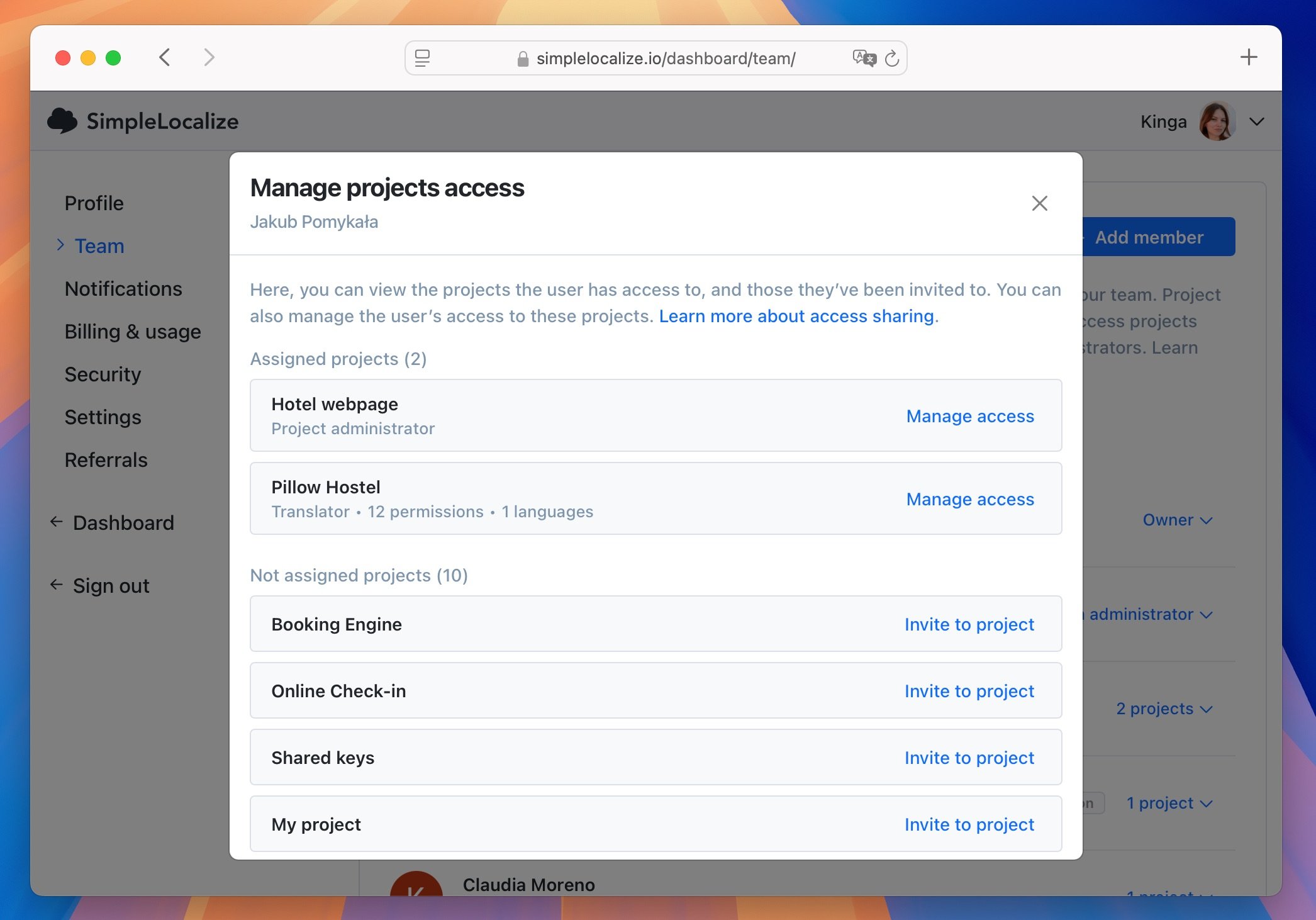
Click on Manage access option in the dropdown menu to manage the accesses and permissions for the team member.
In the popup, you can view the list of projects the team member has access to. You can change the role and permissions for each project and invite the team member to new projects.
Groups
Groups let you define a set of access once and give it to many people at once, instead of configuring every person project by project. A group is a template that it holds one role, a set of permissions, and the list of projects with the language and customer context access inside each of them.
You can find groups in the Groups tab of the Team section. Click Create group to add one. The configuration is the same as inviting a team member: pick the role, choose the permissions, and select the projects together with the language and customer access for each of them.
Groups do not replace the permission system, they are materialized into the regular per-project access. This means that after somebody is added to a group, their access can still be adjusted individually, and removing them from the group never takes any access away.
Custom access
Because individual access can be changed at any time, a person may end up with access that no longer matches their group. For example, after a manual change, or after the group itself was changed without being applied. Such people are marked with Custom access in Manage people, with the exact areas that differ: permissions, languages, customers, or projects. The group row in the list shows how many people it concerns.
To bring somebody back in line with the group, use Reset to group access next to the warning. It gives the person exactly the access of the group, which also means removing them from the team projects the group does not include.
Billing contact
The billing contact is the additional user who is responsible for the subscription billing and receiving invoices. By default, the billing contact is the same as the subscription owner. To change the billing contact, please open the Billing & usage page and click Change address button. If a subscription administrator is assigned as the billing contact, then the user is also allowed to:
- Manage the subscription.
- View invoices.
- Buy additional auto-translation characters.
- Increase translation keys limit.
Transfer project
The project owner can transfer the project ownership to another user that has an active subscription plan. Head to the People tab in the project you want to transfer ownership to and click the Owner role name. There, you can use the Transfer ownership button.

In the popup, you can select the user to whom you want to transfer the project. Remember, only the project owner can transfer the project ownership.
Transfer subscription
If you want to transfer the subscription to another user, please go to the Team management page. Click the owner role name and use the Transfer ownership option.
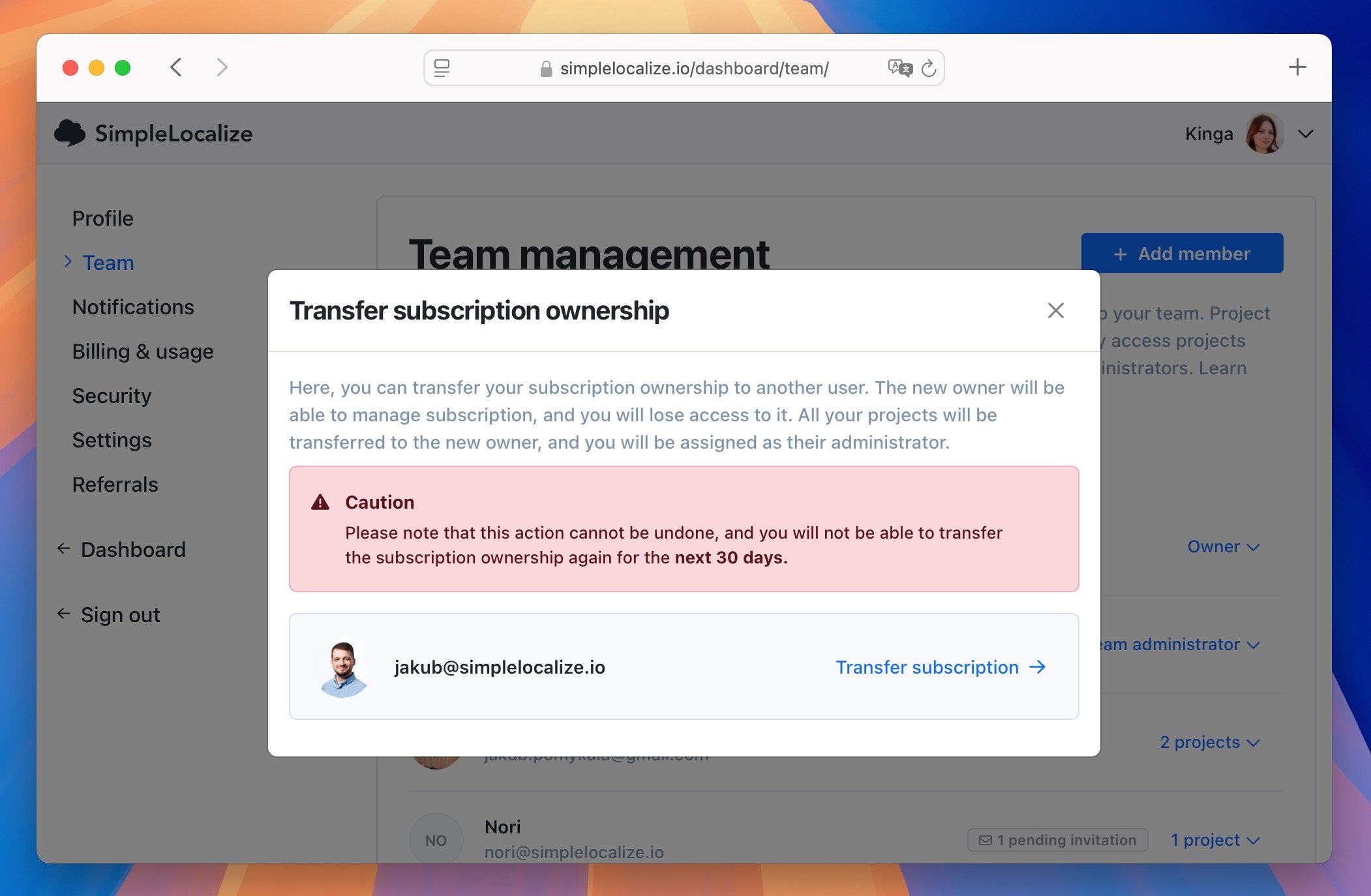
In the popup, you can select the user to whom you want to transfer the subscription. Once you click the 'Transfer subscription' button, the subscription will be transferred to the selected user.
The selected user will become the subscription owner, be able to manage the subscription, and become the project owner for all projects.
After the subscription transfer, you will become an administrator in the subscription and will have access to all projects, but you will not be able to manage the subscription anymore.
Corporate SSO
To learn more about connecting SAML2/OIDC Single Sign-On to SimpleLocalize, please visit the SAML2/OIDC Single Sign-On page.