In your project settings, you can find extra options and settings for Translation Hosting. Go to 'Settings' > 'Hosting' to access them.
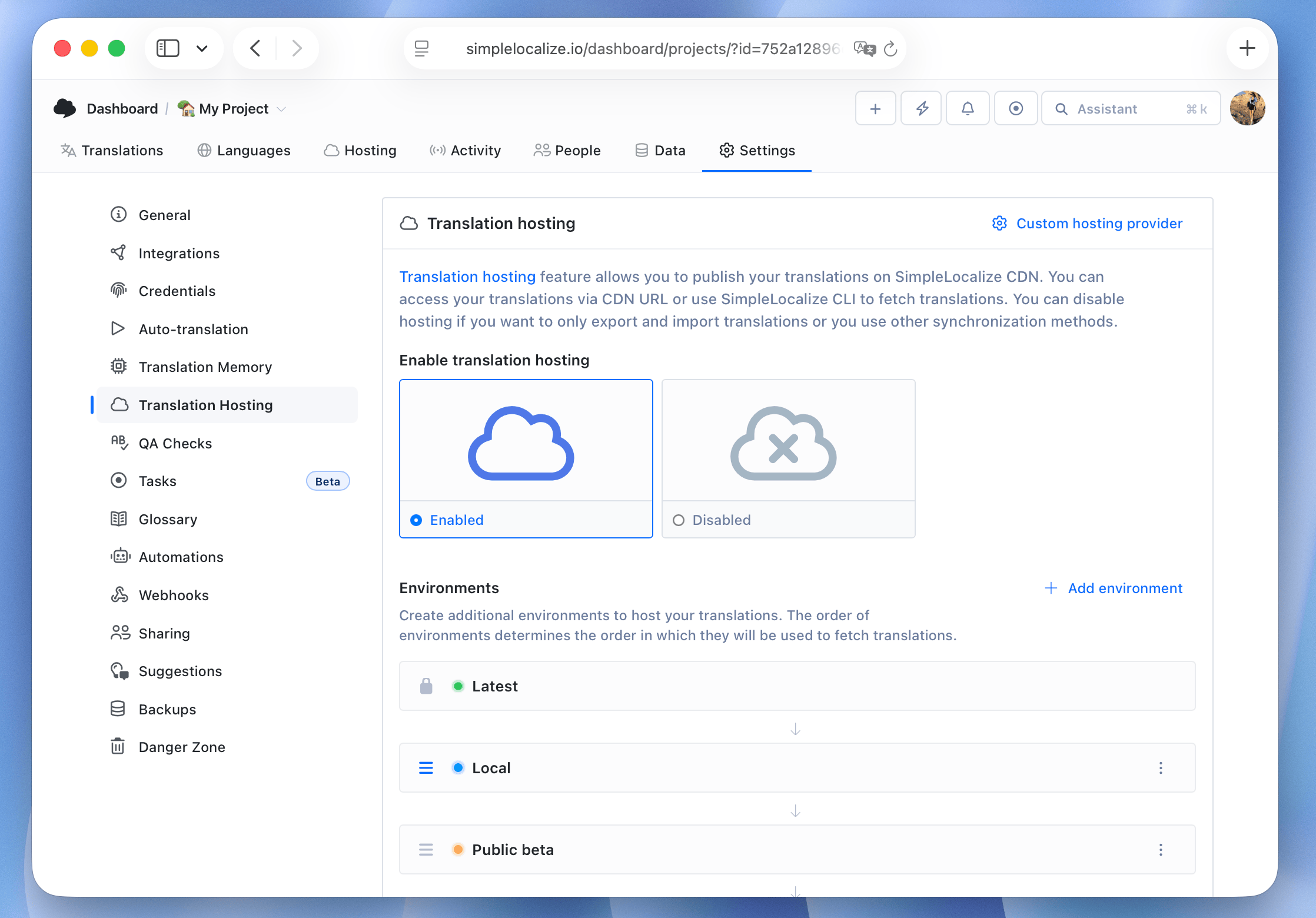
After changing translation hosting settings, you need to publish translations from the 'Hosting' tab in your project to apply changes.
Missing translations
Determine how missing translations should be handled. Here are two options you can customize:
- 'Use empty strings' option will export empty strings.
- 'Exclude missing translations' option will exclude missing translations from the exported JSON.
Fallback translations
Choose the behavior for fallback translations:
- 'Use fallback translations' option will export fallback translations configured in the 'Languages' tab.
- 'Use empty strings' option will export empty strings.
JSON Format
Choose formatting for JSON files, as nested JSON objects or flat JSON objects.
Nested JSON
{
  "en": {
    "key": "value"
  }
}
Flat JSON
{
  "en.key": "value"
}
In some cases nested JSON may cause issues due to conflicting keys. In such cases, you can use a flat JSON format or adjust key namings in the editor.
Publication labels
You can enable "Publication labels" to add in the Publication popup when publishing translations to the hosting environments. This will help you to better identify the publication in the list of publications.
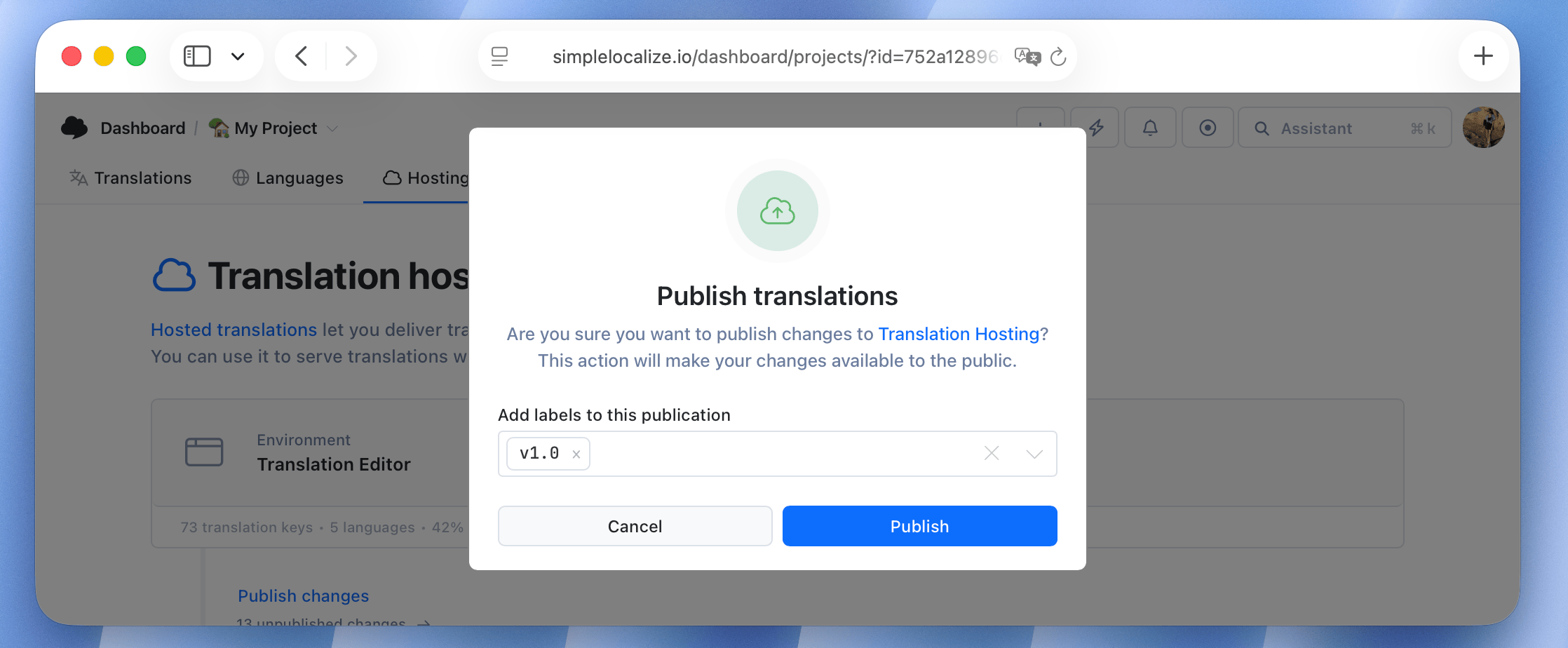
Tag-based publishing
Enable 'Publish translations by tags' to generate separate translation files for each tag assigned to your translation keys.
When enabled, the system will publish a list of tags at /_tags and per-tag files at /_tag/{tag}/{languageKey} and /_tag/{tag}/{languageKey}/{namespace}.
For more information, see the tag-based translations section.
Custom environments
In custom environment section you can create additional environments for your project. For more information, see the custom hosting environments section.