react-i18next vs next-intl: Which should you use for React localization?

Two libraries dominate React localization: react-i18next and next-intl. They solve the same core problem (loading translated strings and rendering them correctly) but make very different architectural assumptions.
This post compares them directly, with code examples and a clear recommendation based on your stack.
If you want the broader architecture and process context (key design, fallback strategy, routing models, and CI/CD workflows), start with the complete technical guide to internationalization and software localization.
The core difference
react-i18next is a framework-agnostic React binding for i18next. It works in any React environment: Vite apps, Create React App, Gatsby, Next.js Pages Router, React Native, Electron. Its plugin ecosystem covers everything from HTTP backends and language detection to ICU message formatting.
next-intl is built specifically for Next.js. It has first-class support for the App Router, server components, and Next.js's built-in locale routing. If you're not using Next.js, it's not an option.
If you're on the older Next.js Pages Router, next-i18next is the common i18next wrapper for that setup; this comparison focuses on react-i18next directly versus next-intl because that's the more relevant choice for new App Router projects.
The decision tree is short: if you're on Next.js App Router and want tight framework integration, next-intl is the natural choice. If you need flexibility across environments, or you're not on Next.js, react-i18next is the right call.
Setup comparison
react-i18next
react-i18next requires more upfront configuration but rewards you with more control. You initialize it once, typically in an i18n.ts file, and import that file at your app entry point.
npm install react-i18next i18next i18next-http-backend i18next-browser-languagedetector
// i18n.ts
import i18n from 'i18next';
import Backend from 'i18next-http-backend';
import LanguageDetector from 'i18next-browser-languagedetector';
import { initReactI18next } from 'react-i18next';

i18n
  .use(Backend)
  .use(LanguageDetector)
  .use(initReactI18next)
  .init({
    fallbackLng: 'en',
    backend: {
      loadPath: 'https://cdn.simplelocalize.io/YOUR_PROJECT_TOKEN/_latest/{{lng}}',
    },
  });

export default i18n;
Then in your component:
import { useTranslation } from 'react-i18next';

function BookingButton() {
  const { t } = useTranslation();
  return <button>{t('pillow_hotel.booking.confirm')}</button>;
}
The i18next-http-backend plugin fetches translations from a URL at runtime. This is how SimpleLocalize's translation hosting CDN integrates: translations live on the CDN and are fetched by the browser without a rebuild.
next-intl
next-intl requires less wiring for Next.js projects, but the idiomatic App Router setup is request-based on the server (not importing a static locale JSON directly in the root layout).
npm install next-intl
Enable the plugin in your Next.js config:
// next.config.ts
import createNextIntlPlugin from 'next-intl/plugin';

const withNextIntl = createNextIntlPlugin();

const nextConfig = {};

export default withNextIntl(nextConfig);
Then define request-scoped message loading:
// i18n/request.ts
import { getRequestConfig } from 'next-intl/server';

export default getRequestConfig(async ({ requestLocale }) => {
  const locale = requestLocale ?? 'en';

  return {
    locale,
    messages: (await import(`../messages/${locale}.json`)).default,
  };
});
And provide messages in the locale layout:
// app/[locale]/layout.tsx
import { NextIntlClientProvider } from 'next-intl';
import { getMessages } from 'next-intl/server';

export default async function LocaleLayout({
  children,
  params,
}: {
  children: React.ReactNode;
  params: Promise<{ locale: string }>;
}) {
  const { locale } = await params;
  const messages = await getMessages();

  return (
    <html lang={locale}>
      <body>
        <NextIntlClientProvider messages={messages}>
          {children}
        </NextIntlClientProvider>
      </body>
    </html>
  );
}
// Any component
import { useTranslations } from 'next-intl';

export default function BookingButton() {
  const t = useTranslations();
  return <button>{t('pillow_hotel.booking.confirm')}</button>;
}
The hook names differ slightly: useTranslation in react-i18next vs useTranslations in next-intl. Worth noting when switching between projects.
Learn more about the Next.js App Router localization setup in our next-intl guide.
Pluralization and interpolation
Both libraries handle pluralization well, but with different defaults. next-intl uses ICU message syntax out of the box. i18next/react-i18next supports plural rules natively (JSON v4 key patterns like _one, _other) without extra plugins; add i18next-icu if you want full ICU message syntax in i18next too.
react-i18next (default format, not ICU):
{
  "rooms_booked_one": "You booked {{count}} room",
  "rooms_booked_other": "You booked {{count}} rooms"
}
next-intl (ICU, built in):
{
  "rooms_booked": "{count, plural, one {You booked # room} other {You booked # rooms}}"
}
Both approaches scale to languages like Polish (three plural forms) or Arabic (six), as long as your keys/messages are structured correctly. For a full breakdown, see how to handle pluralization across languages.
Locale detection
react-i18next handles locale detection via the i18next-browser-languagedetector plugin, which checks cookies, localStorage, the Accept-Language header, and URL parameters, in a configurable order.
next-intl relies entirely on Next.js routing. Locale is resolved in middleware and encoded in the URL path (/en/checkout, /de/checkout). There's no client-side detection plugin; the framework handles it. This is actually the more correct approach for SEO: URL-based locale detection is indexable, shareable, and cacheable. See the trade-offs in our locale detection strategies guide.
Server components
This is where developer experience diverges. In Next.js App Router, server components can't use standard client React hooks.
next-intl provides a separate getTranslations() function for server components:
// Server component
import { getTranslations } from 'next-intl/server';

export default async function BookingSummary() {
  const t = await getTranslations();
  return <h1>{t('pillow_hotel.booking.summary')}</h1>;
}
react-i18next can also be used in server components, typically with a request-scoped i18next instance (or a thin framework wrapper) so each request gets isolated language state. That is no longer a hard limitation, but it is still more boilerplate than next-intl's built-in server utilities.
Translation file management with SimpleLocalize
Both libraries integrate with SimpleLocalize, but in different ways.
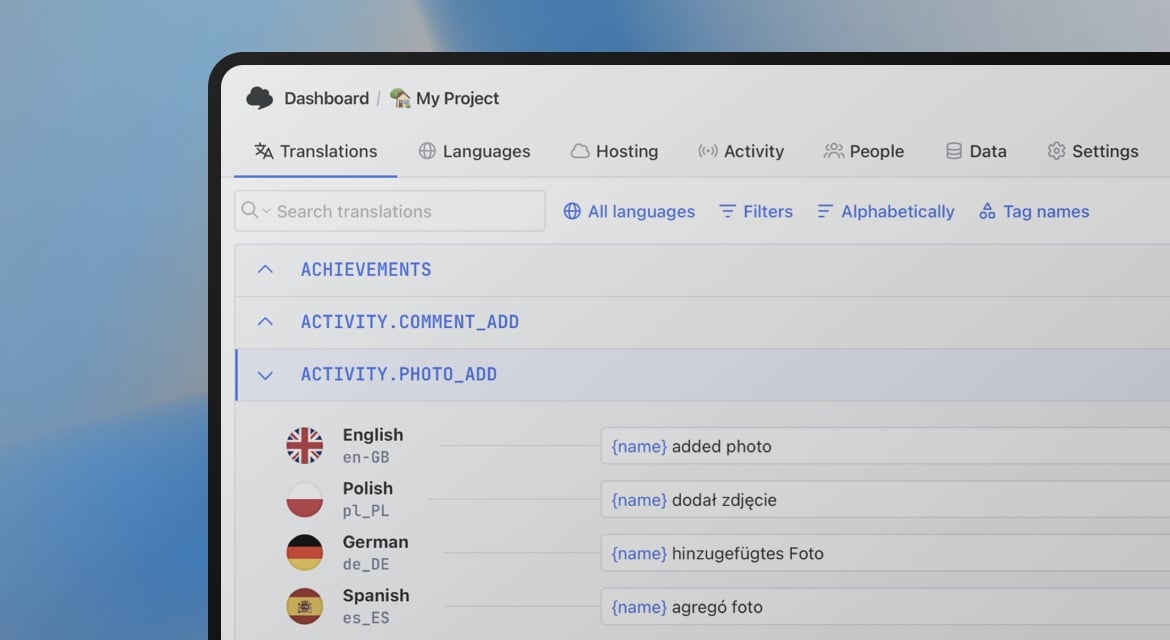
react-i18next can use SimpleLocalize's translation hosting CDN directly via i18next-http-backend. Translations are fetched at runtime with no file management required in the codebase. You update a translation in the editor, click "Save & Publish," and users get the new string without a redeploy.
The CDN load path looks like:
https://cdn.simplelocalize.io/YOUR_PROJECT_TOKEN/_latest/{{lng}}
With namespaces:
https://cdn.simplelocalize.io/YOUR_PROJECT_TOKEN/_latest/{{lng}}/{{ns}}
next-intl typically uses static JSON files per locale. You manage them with the SimpleLocalize CLI and a simplelocalize.yml config:
apiKey: YOUR_PROJECT_API_KEY
uploadFormat: single-language-json
uploadLanguageKey: en
uploadPath: ./messages/en.json
uploadOptions:
  - UPDATE_TRANSLATIONS

downloadFormat: single-language-json
downloadLanguageKeys: ['de', 'pl', 'fr']
downloadPath: ./messages/{lang}.json
Then in CI/CD:
simplelocalize upload   # push source strings
simplelocalize download # pull completed translations
Translations are pulled into your repo and shipped with each deployment. This deterministic-build workflow is usually the default choice for Next.js teams.
If you want runtime updates without redeploys, next-intl can fetch messages dynamically in i18n/request.ts (for example, from the SimpleLocalize CDN via fetch()). That gives you the same "publish and see it live" behavior, with the usual runtime trade-offs around caching and request latency.
See the full setup details in the SimpleLocalize docs for i18next and next-intl.
Side-by-side comparison
Here is a quick reference table for the two libraries:
| react-i18next | next-intl | |
|---|---|---|
| Framework | Any React environment | Next.js only |
| App Router server components | Supported with request-scoped setup | First-class support |
| ICU/plurals | Native plurals; ICU via plugin | ICU built in |
| Locale detection | Plugin-based, flexible | URL-based via Next.js routing |
| Translation delivery | CDN fetch at runtime | Static files or edge-fetched JSON |
| Namespace support | Yes | Yes |
| TypeScript | Yes | Yes, with type-safe keys |
| Bundle size | Larger (plugin ecosystem) | Lighter (focused on Next.js) |
| SimpleLocalize integration | CDN hosting or CLI | CLI sync |
Which one should you choose?
Use next-intl if:
- You're building a Next.js app, especially with App Router
- You want type-safe translation keys (next-intl generates types from your JSON files)
- You prefer URL-based locale routing for SEO
- Your team is comfortable with file-based translation management and CI/CD
Use react-i18next if:
- Your project isn't tied to Next.js (Vite, React Native, Electron, Gatsby)
- You want runtime translation updates without rebuilding and redeploying
- You need advanced plugin support (ICU, language detection, custom backends)
- You already use i18next elsewhere in your stack and want consistency
Both are production-proven at scale. The choice comes down to your framework and delivery requirements, not quality.
Further reading
- Complete technical guide to internationalization and software localization
- i18next and React application localization in 3 steps
- How to translate a Next.js app with next-i18next
- Locale detection strategies: URL, Cookie, or Header?
- How to handle pluralization across languages
- Lazy loading translations in React with code-splitting