SimpleLocalize offers a few ways to bring back previous versions of your translation data in the translation editor:
- Automated snapshots that are created before significant actions in your project.
- Manual snapshots that you can create and name whenever you need.
- Importing files that you have previously imported or exported.
- Importing files from translation hosting if you are using that feature.
If you are looking at how to revert currently hosted translations, then please go to Translation Hosting Rollbacks section.
Always read carefully the descriptions of the options before performing any restore action to avoid unintentional data loss. If you are unsure, contact our support team for assistance.
Automated snapshots
Snapshots are saved states of your translation project. SimpleLocalize creates them automatically before significant changes, so you can always go back to the state from before the change.
Automated snapshots are created:
- before importing translations,
- before deleting a language or a customer context,
- before bulk actions, such as changing review statuses, changing namespaces, or clearing translations,
- before deleting translation keys that are not present in an uploaded file,
- before clearing project data,
- before restoring a backup,
- periodically, once a week if there were any changes in the project, or after more than 1,000 changes.
Snapshots are kept for 90 days.
What is included in a snapshot
Every snapshot contains:
- languages (codes, names, flags, order, default language and auto-translation provider)
- customer contexts
- tags (names and colors)
- translation keys and namespaces
- translation key descriptions and code descriptions
- translation key tags
- translation key character limits, deprecation, locked translations and disabled auto-translation flags
- translation key options and custom attributes (for example, gettext context, XLIFF notes or Figma node IDs)
- translation texts
- translation review statuses
- translation auto-translation statuses
Snapshots do not contain project settings and translation key screenshots.
Create a snapshot manually
You can create a snapshot at any time, for example, before a release or a large change in your project. Open your project, go to Settings > Snapshots, and click Create snapshot. Give the snapshot a name, like "Before release 2.0", to find it easily later.
To change or remove the name of an existing snapshot, open the menu (⋮) next to it on the list and click Rename.
Restore from a snapshot
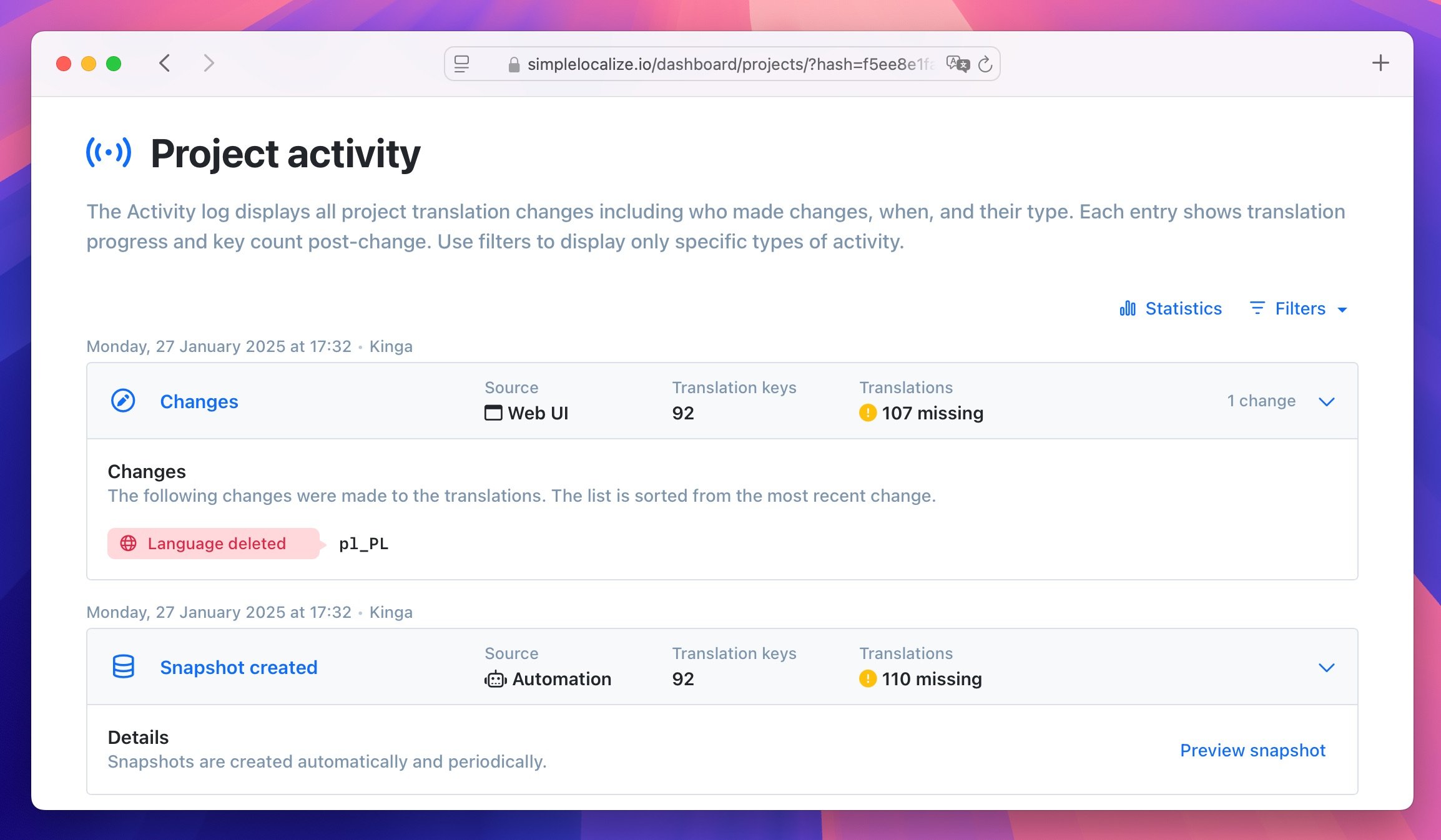
You will find all snapshots of your project in Settings > Snapshots. Click a snapshot name, or open the menu (⋮) next to it and click Revert, to open the snapshot. Snapshots are also available in the Activity tab, after you change the Filter and select the action type Snapshots.
The snapshot preview shows the number of translation keys, languages, and translations at the time it was created. You can also compare the snapshot with the current state of your project, language by language, to see exactly what will change after restoring it.
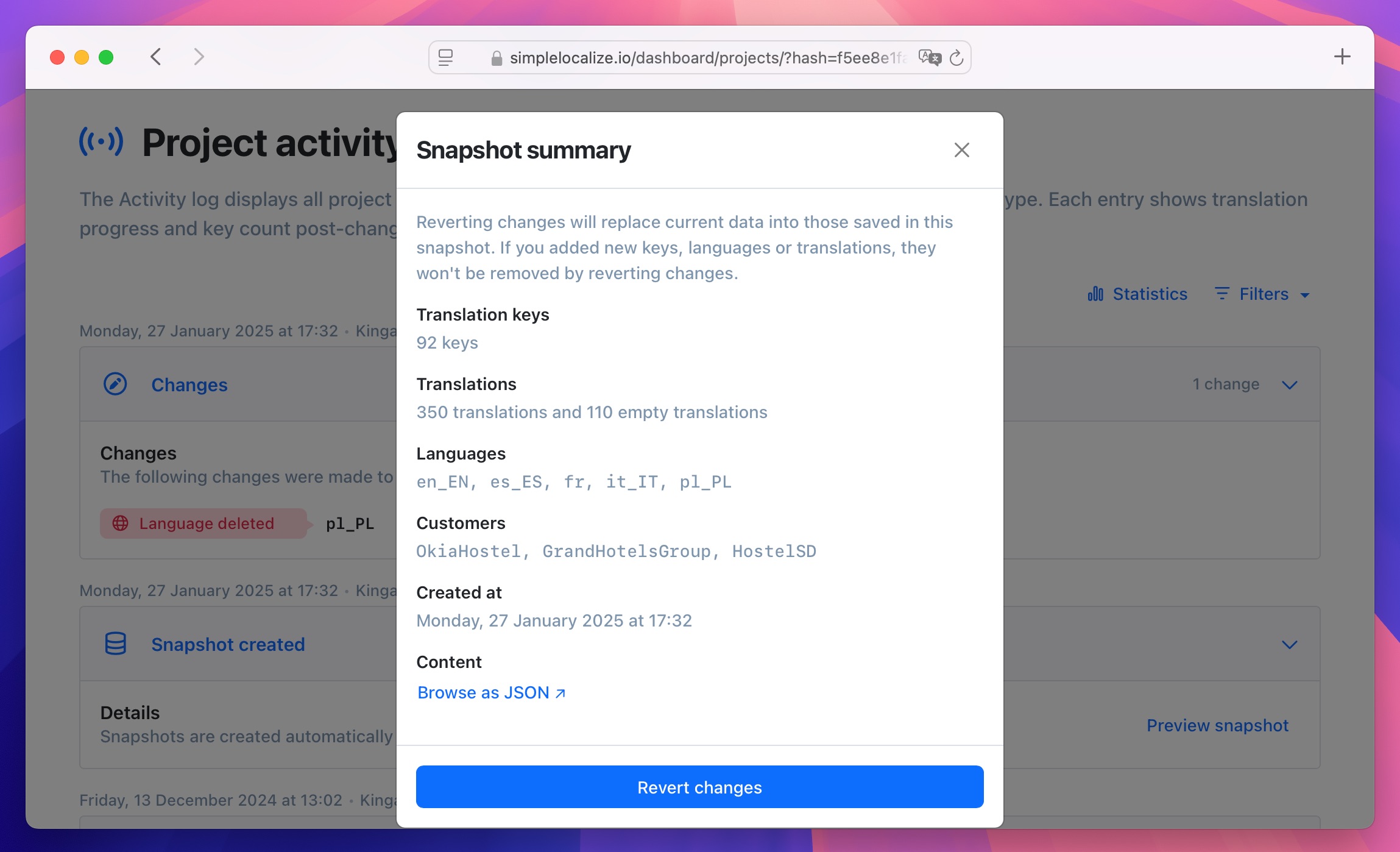
Restoring a snapshot brings back the translations, languages, customer contexts, tags, and translation key details saved in the snapshot.
Restoring a snapshot runs in the background and may take a few minutes, depending on the size of your project.
Restoring a snapshot does not delete data added after the snapshot was created. If you added new translation keys or languages since then, you need to delete them manually.
Backups
Backups are deprecated, and creating new backups is no longer available. We recommend using snapshots instead.
Backups created in the past are still available in Settings > Snapshots under Manual backups. You can restore them or delete them when you no longer need them.
Backups do not contain tags, translation key custom attributes, or translation key screenshots.
Restore backup
You have two options when restoring a backup: create a new project from the backup or restore the backup and override the existing project.
Create a new project from backup
This option copies the project version from the selected backup to a newly created project. It's a safe way of restoring your translations without the risk of losing any current data.
Restore backup and override existing project
By selecting this option, you will overwrite the current translation data with the data from the chosen backup. All current translations, languages, customer contexts, and settings will be replaced with the data from the backup. Tags assigned to translation keys will be removed, as backups do not contain them.
SimpleLocalize creates a snapshot of your project before restoring a backup, so you can go back to the previous state from the snapshot if needed.
Reverting changes via previous files
Another option to revert translations is by using files that you have previously imported or exported. You will find all your files in the Activity tab of your project. You can download those files and re-import them to your project to revert translations. Remember to select the correct file format when importing.
Reverting changes via translation hosting
If you are using Translation Hosting, you can also use those files to revert translations in your translation editor. Get the desired version of your translations from the Hosting tab, it could be the version from rollback or currently hosted version.
Then import those files back to your translation project in the Data tab.
- For
_indexfiles with all translations then usemulti-language-jsonfile format. - For language-specific files then use
single-language-jsonfile format.
I need assistance
In case of any doubts or questions, feel free to reach out to our support team for assistance. We are here to help you ensure the safety and integrity of your translation data.